Frequently Asked Questions
Nri Banking
FCNR(B) vs US Treasury Bonds: What NRI & PIO in America Should Know in 2026
FCNR(B) deposits offer US-based NRIs competitive USD returns, Indian tax benefits, full repatriation, and require FATCA/US tax compliance.
Synopsis:
- Compares FCNR(B) deposits with US Treasuries for smarter NRI investment decisions.
- Explains RBI's 2026 changes and their impact on USD FCNR(B) returns.
- Covers key US tax, FATCA, and DTAA considerations for NRIs.
- Highlights FCNR(B) as a secure, repatriable option for India-linked financial goals.
Overview
For NRI & PIO living in the United States, 2026 presents an unusually interesting comparison. US Treasury yields are sitting around [VERIFY: 4.5%], which makes them a credible benchmark for any India-linked fixed-income option. At the same time, RBI’s June 2026 relaxation have pushed USD FCNR(B) deposit interest rates up meaningfully — making this a genuine conversation, not a default choice in either direction.
This article breaks down how FCNR(B) deposit compares for US-based NRIs, what you need to know about FATCA and DTAA, and how to think about the two as complementary parts of a cross-border portfolio.
The US-Based NRI’s Situation
You earn in dollars, your financial life is anchored in the US, and you likely have family ties, property aspirations, or a retirement plan linked to India. Your challenge isn’t just finding a good interest rate — it’s finding a good interest rate in a structure that works across two different regulatory and tax systems. FCNR(B) deposit is one of the few products that genuinely fits this picture: USD-denominated, held in India, but with none of the currency conversion or repatriation friction that rupee-based deposits carry.
Latest RBI Update on the FCNR(B) Window
RBI introduced a special forex swap facility in June 2026 for banks mobilising eligible FCNR(B) Deposits. Following a strong response and significant foreign currency inflows, RBI has now brought forward the mobilisation deadline for eligible FCNR(B) deposits to August 31, 2026.
For customers, the key distinction is that August 31 is the revised deadline for deposits eligible under RBI's special swap facility. It is not the closing date for the regular FCNR(B) Deposit product.
The India Tax Angle: DTAA and What It Means
FCNR(B) deposit interest is fully exempt from income tax in India for NRI/PIO. India does not deduct TDS on FCNR(B) deposit interest. However, US-based NRI/PIO need to factor in US tax rules:
The US taxes its citizens and green card holders on worldwide income, including foreign interest income
H-1B, L-1, and other visa holders on the Substantial Presence Test are also subject to US taxation on FCNR(B) interest
The India-USA Double Taxation Avoidance Agreement (DTAA) allows you to claim a foreign tax credit in the US — but since India doesn’t tax FCNR(B) interest, there may be no Indian tax paid to offset against your US liability.
Note: FCNR(B) interest is likely reportable on your US tax return. The Indian tax exemption is an India-side benefit, not a US-side one. Consult a US-India crossborder tax advisor before making a decision based solely on the tax angle.
FATCA: What US-Based NRIs Need to Declare
The Foreign Account Tax Compliance Act (FATCA) requires US persons to report foreign financial accounts above certain thresholds. An FCNR(B) deposit held at an Indian bank is a foreign financial account for this purpose. If your FCNR(B) deposit exceeds the applicable threshold, you will need to:
Report it on your FBAR (FinCEN Form 114)
Potentially include it in your FATCA filing (Form 8938)
This is a standard compliance requirement — not a reason to avoid FCNR(B) deposit, but something to handle correctly. HDFC Bank is a FATCA-compliant institution and will collect your US person status at account opening.
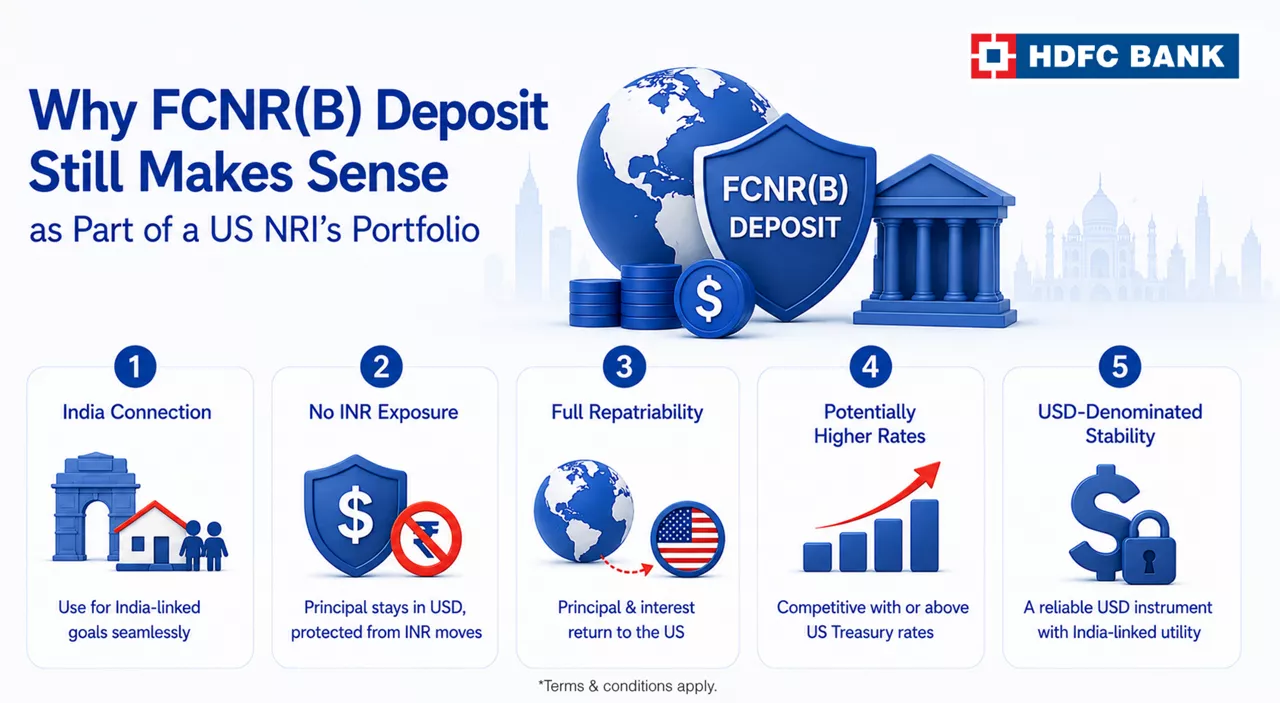
Why FCNR(B) Deposit Still Makes Sense as Part of a US NRI’s Portfolio
Despite the US tax reporting requirement, FCNR(B) deposit offers things a US Treasury cannot:
India connection: proceeds can be used directly for India-linked goals — property purchase, parental support, future return — without currency conversion friction
No INR exposure: unlike NRE fixed deposits, FCNR(B) deposit keeps your principal in USD throughout, so your India corpus doesn’t shrink if the rupee weakens
Full repatriability: principal and interest can come back to the US at any time after maturity
Potentially higher rate: post-June 2026 relaxation, competitive with or above comparable US Treasury rates for 3-5 year tenors
The strongest case for FCNR(B) deposit isn’t that it replaces US Treasuries — it’s that it fills a different slot: a USD-denominated instrument with India-linked utility and competitive returns.
How to Open an FCNR(B) deposit with HDFC Bank from the US
HDFC Bank supports non-face to face account opening for new to bank NRI/PIO customers. You will need:
A valid Passport copy
Address proof
Proof of NRI/PIO status
PAN card
FATCA self-certification (collected at account opening)
Documents to be certified by designated authorities prescribed by RBI
Booking can be done via wire transfer from your US bank account.
*Disclaimer: Terms and conditions apply. The information provided in this article is generic in nature and for informational purposes only. It is not a substitute for specific advice in your own circumstances. Consult a qualified US-India tax advisor for guidance specific to your situation. Rates and terms are subject to change. Please refer to HDFC Bank’s official FCNR(B) rate card for the most current information.
Likely yes — it is generally reportable as foreign interest income on your US return. The India-side exemption does not apply in the US. Consult a cross-border tax advisor for your specific situation.
If the balance exceeds applicable FBAR/FATCA thresholds, yes. This is standard for any foreign financial account held by a US person.
Yes. US citizens of Indian origin who qualify as NRI/PIO/OCI under FEMA can open FCNR(B) accounts.
USD is the most practical option, but HDFC Bank offers FCNR(B) in multiple currencies. For US-based NRIs, USD typically offers the most direct fit.

Related Blogs


Make the most of your savings with our foreign
currency deposits