Frequently Asked Questions
Nri Banking
A Guide to FCNR(B) Deposits for NRIs Living in Dubai and the UAE
Understand FCNR(B) Deposits for UAE NRIs, including USD options, taxation, repatriation and key benefits.
Synopsis
- FCNR(B) Deposits allow eligible UAE-based NRIs to maintain foreign-currency deposits with an Indian bank.
- USD FCNR(B) Deposits can be relevant for UAE residents due to the AED-USD currency relationship.
- Eligible principal and interest are repatriable, subject to applicable regulations and Bank terms.
- Consider currency, tenure, liquidity and taxation before booking an FCNR(B) Deposit.
Overview
For NRIs living and working in Dubai or elsewhere in the UAE, an FCNR(B) Deposit can provide an option to maintain eligible foreign-currency savings with an Indian bank without converting the deposit into Indian Rupees.
FCNR(B), or Foreign Currency Non-Resident (Bank), Deposits are term deposits available to eligible non-resident customers in permitted foreign currencies.
For UAE-based NRIs, USD FCNR(B) Deposits can be particularly relevant because the UAE Dirham is pegged to the US Dollar. However, the choice of deposit currency should ultimately depend on your existing savings and future financial requirements.
Why UAE-Based NRIs May Consider FCNR(B) Deposits
The AED-USD link makes currency choice simple. The UAE Dirham has been pegged to the US Dollar since 1997 at a fixed rate. This means that for a UAE-based NRI, opening a USD-denominated fcnr b deposit is effectively holding savings in the same currency your salary arrives in — there is no meaningful conversion risk at the source.
The double-zero tax advantage. UAE levies no personal income tax. India exempts FCNR(B) interest from income tax for NRIs. This combination means your returns from an FCNR(B) deposit are tax-free in both jurisdictions — a genuinely unusual position for any investment product.
No TDS deducted in India. Unlike NRO accounts where TDS is deducted at source, FCNR(B) interest is paid without any Indian tax deduction. You receive the full stated rate.
Remittance flows are already high. The UAE is consistently among the top sources of remittances to India. Many UAE-based NRIs are already moving money to India — an FCNR(B) deposit simply ensures that money is working at its highest potential rather than sitting in a low-yield account.
Why USD FCNR(B) Deposits May Be Relevant in the UAE
The UAE Dirham is pegged to the US Dollar. This makes USD a familiar currency reference for UAE-based residents and can make a USD FCNR(B) Deposit relevant for some NRIs.
However, currency selection should not be based on interest rates alone.
Consider the currency in which you currently hold your savings, where you expect to use the money in the future, and any currency-conversion costs involved.
FCNR(B) Deposit vs NRE Fixed Deposit
One important difference between an FCNR(B) Deposit and an NRE Fixed Deposit is the currency.
An FCNR(B) Deposit is maintained in an eligible foreign currency, whereas an NRE Fixed Deposit is maintained in Indian Rupees.
UAE-based NRIs should consider their future currency requirements, prevailing interest rates, tenure, liquidity and exchange-rate exposure when evaluating these options.
Taxation and Repatriation
Interest earned on eligible FCNR(B) Deposits is exempt from income tax in India, subject to applicable regulations and eligibility conditions.
The principal and interest are also repatriable, subject to applicable regulations and Bank terms.
While the UAE generally does not impose personal income tax on individuals, customers should consider their individual tax residency and applicable regulations, particularly if they have financial or tax obligations in multiple countries.
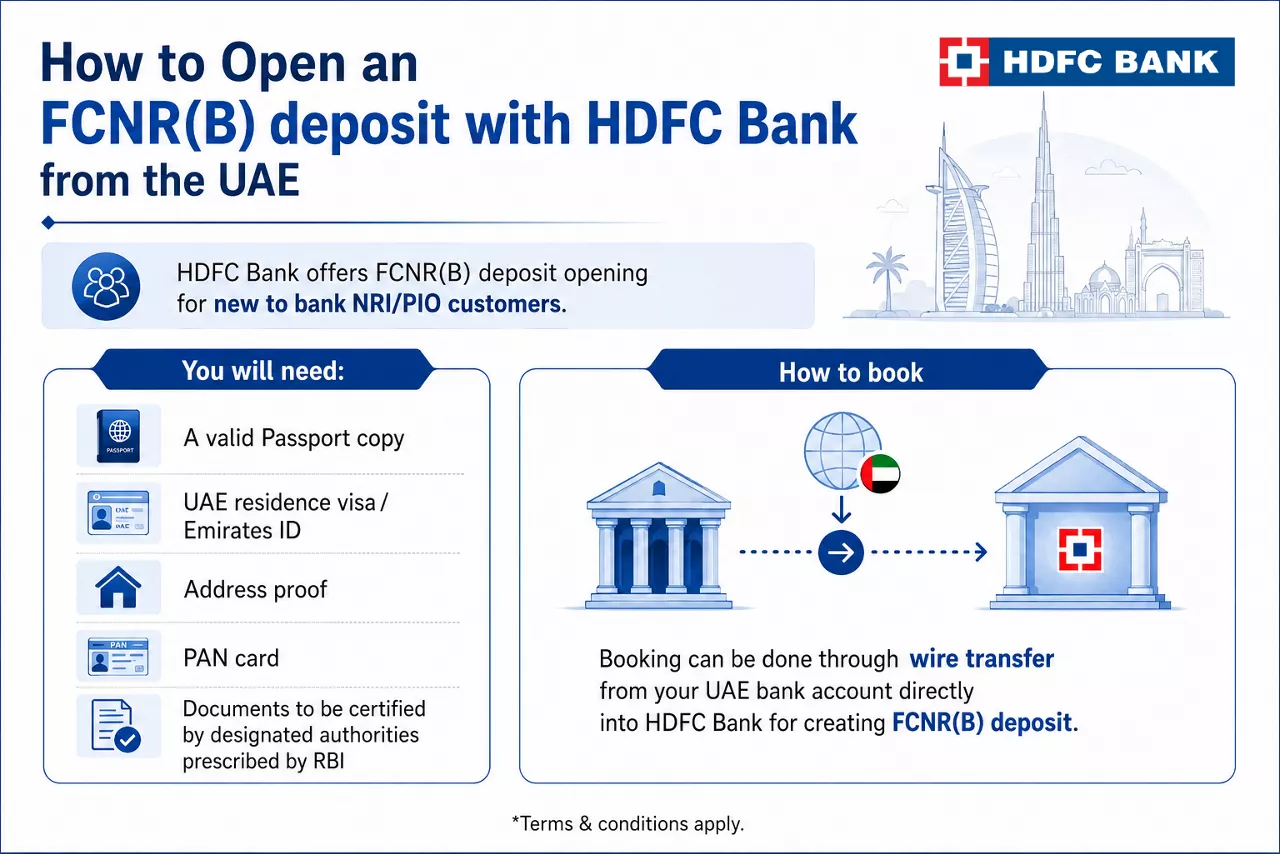
How to Open an FCNR(B) Deposit from the UAE
Eligible NRIs can fund an FCNR(B) Deposit through permitted foreign remittance or other eligible funding routes.
Before booking:
- Select the preferred eligible currency.
- Choose a suitable deposit tenure.
- Check the latest applicable interest rate.
- Review premature withdrawal conditions.
- Check remittance and intermediary-bank charges.
- Review maturity and renewal instructions.
Existing eligible HDFC Bank customers may also have digital booking options, subject to applicable product terms.
Conclusion
For NRIs in Dubai and the UAE, an FCNR(B) Deposit provides an option to maintain foreign-currency savings with an Indian bank while retaining flexibility over currency and tenure.
Before booking, consider your future currency requirements, liquidity, tenure, taxation and applicable product terms rather than focusing on the interest rate alone. Always check the latest HDFC Bank FCNR(B) rates and terms before making a deposit decision.
*Disclaimer: Terms and conditions apply. The information provided is generic and for informational purposes only. Interest rates, regulatory requirements and product terms are subject to change. Please refer to HDFC Bank's latest FCNR Deposit rate card and applicable terms before making a decision.
Yes. UAE has no personal income tax. India exempts FCNR(B) interest income for NRIs. No tax applies in either country on the interest earned.
FCNR(B) deposits accept supported foreign currencies. USD is the most common choice for UAE-based NRIs given the AED-USD peg. Check HDFC Bank’s supported currency list.
Minimum deposit thresholds vary by bank and currency. Check HDFC Bank’s FCNR(B) deposit terms for the applicable minimum amount.
Yes. HDFC Bank supports online deposit booking through netbanking for existing customers and non-face to face account opening cum deposit booking for new to bank NRI/PIO customers. Documentation for non-face to face NR account opening can be submitted via courier provided are additionally certified by designated authorities prescribed by RBI.
If your residential status changes to Resident Indian, FCNR(B) deposit will continue till maturity. Interest earned from said deposit needs to be reported by customers independently to Indian income tax authorities and pay the applicable taxes since bank will not deduct TDS from their end. Discuss with your HDFC Bank relationship manager when this happens.

Related Blogs


Make the most of your savings with our foreign
currency deposits