


What’s in store for you?



Why invest in NPS?

Types of NPS Account
You can open two sub-accounts under the same Permanent Retirement Account Number (PRAN) in the NPS, known as tiers


Tax Benefits


Key Benefits & Features of NPS
You can open two sub-accounts under the same Permanent Retirement Account Number (PRAN) in the NPS, known as tiers
-
NPS Account Opening Contribution
-
Models of NPS Accounts
-
Entities Involved in NPS
-
Benefits of Investing in NPS Through SIP
-
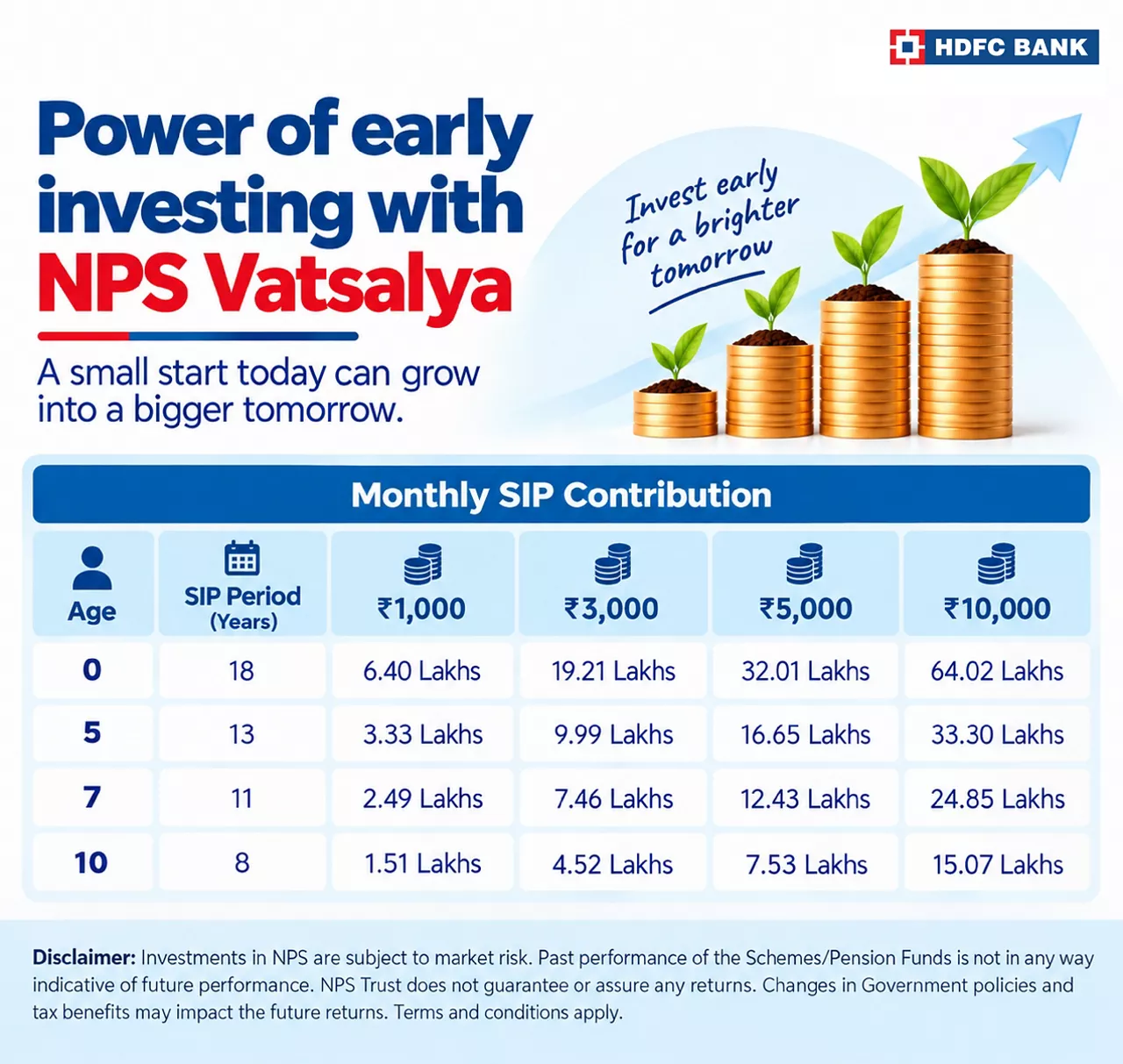
NPS Vatsalya
-
Corporate Benefit
-
Investment Option
-
Fees & Charges
-
Withdrawal
-
Most Important Terms & Conditions
-
Disclaimers
-
Regulatory Disclosure (NPS)


How to apply for NPS Scheme?
- You can enrol for NPS online in paperless process through our website from the convenience of your home / office. The prime objective of the scheme is to provide all citizens of India with an attractive long-term savings avenue to plan for retirement through safe and reasonable market-based returns. The account can be opened by all Indian Citizens between 18 to 70 Years. Apply Online
- Steps for online account opening:
- You can enrol for NPS by clicking on 'Apply Now' option under NPS (National Pension System)
- You can choose any one CRA to open the account (K-Fin Technologies Private Limited, CAMS CRA or Protean e-Gov technologies limited.)
- You will get online form, which needs to be filled with mandatory fields.
- Acknowledgement Id for your registration (account opening) will be generated. There will be provision to complete the registration (account opening form) later, but within 15 days, based on acknowledgement number search.
- CKYC option as the first mode of regisrtation. KYC details under CKYC based option will be taken from CERSAI database.
- Pan based – HDFC Bank will verify KYC on the basis of details maintained in your account with Bank. (Hence details being input in NPS should be exactly as per bank account).
- Offline Aadhaar KYC – KYC details will be taken from the database of UIDAI.
- You need to share detail like Bank details, scheme details, nominee details etc.
- You need to upload photograph, specimen signature, cancelled cheque / bank statement / passbook copy and PAN copy as per file size permissible.
- You need to make initial contribution of min ₹500.
- You will be directed to online payment platform wherein you will complete the payment through HDFC Bank NetBanking or UPI.
- On successful payment, 12-digit PRAN will be allotted to you and PDF form will be generated based on data given.
- PRAN will be communicated to you via registered email and SMS.
- E-Sign/OTP – You will have to complete online e-sign or OTP based confirmation once registration process is completed. This is to avoid physical submission of registration form.
- Click here to know more
More About NPS Scheme
- Benefits of the National Pension System
- The National Pension System (NPS) offers several benefits. It provides a regulated, transparent, and secure way to save for retirement, overseen by the Pension Fund Regulatory and Development Authority (PFRDA). NPS allows voluntary contributions, offering flexibility in investment amounts and timing. Subscribers can choose or change their investment patterns and fund managers to optimise returns across asset classes like Equity, Corporate Bonds, and Government Securities. NPS is cost-effective, with low fees compared to other investment options. Additionally, the NPS account is portable, maintaining the same PRAN regardless of changes in employment or location, and allows tax-beneficial superannuation fund transfers.
- Documents required for investing in the National Pension System
- To enrol in the National Pension System (NPS), you need the following documents: proof of identity (such as Aadhaar card, PAN card, driver’s license, Voter’s ID, or passport), proof of address (like utility bills, bank statements, or rental agreements), and a recent passport-sized photograph. Additionally, you must provide a cancelled cheque from your bank account to facilitate contributions and withdrawals. If you are enrolling through an employer, you might need a filled NPS registration form authorised by your employer. For NRIs, a valid passport and proof of overseas address are required. These documents ensure a smooth and compliant registration process.
- NPS Facilities
- NPS on mobile Application: A mobile app for NPS Subscribers. You can view your NPS account, scheme holdings, latest Net Asset Value (NAV) and the total value of the schemes through this app. You can view the transaction statement for a particular financial year, as well as details of last five contributions. You can switch among fund managers, asset classes and change the allocation ratio.
- You can login to your NPS Account using the following links.
- https://nps.kfintech.com/
- https://www.npscra.nsdl.co.in/
- Login|CAMS eNPS |NPS Subscribers| , National Pension Scheme
- Download Mobile App
- K-fintech Mobile App
- NSDL Mobile App
- CAMs Mobile App Link
- Facilities available in Subscriber’s login:
- View profile details
- Transaction Statement
- Statement of Holding
- Contribution Statement
- Transaction through OTP authentication
- Contribution
- Tier II withdrawal
- Scheme Preference change
- One Way Switch (from Tier II to Tier I)
- Reprint of PRAN Card
- Change of contact details
- Change of address using Aadhaar authentication
- Grievance facility
- Various Views
- E-PRAN view and download
- NAV details
- Tier II details
- POP (Point Of Presence) details
- Facilities outside login:
- Contribution
- Tier II activation
- IPIN reset
Frequently Asked Questions
All major Scheduled Indian Banks are available for making SIP payment. Currently, you may setup SIP through 43 banks. The list is continuously expanding with more and more Banks coming forward for participation on the NPCI platform facilitating this service (eNACH).
You do not need to worry, as the amount shown is the maximum amount for which NACH mandate is presented to your bank. As NPS is a long term investment vehicle, this is done to ensure uninterrupted contributions and avoid any inconvenience to you in future arising out of change in regulatory guidelines regarding charges. Rest assured, only the amount intended/mandated to be contributed through SIP will be debited from your account. You will also receive intimation about the same on the mode of communication (email ID/mobile number/both) post authorisation by you on your bank’s Internet Banking page.
There are two charges associated with setting up an SIP under NPS:
- One time SIP Initiation & Cancellation charge is INR 3.50 per mandate (to be charged directly from subscriber through unit deduction by CRA during the quarterly billing activity)
- PoP charges for recurring contribution SIPs to the NPS account
Contribution charges under NPS are defined by the Regulator i.e. Pension Fund Regulatory & Development Authority (PFRDA). Thus, all recurring SIP transactions are treated as contribution transactions and charges as prescribed by PFRDA are levied by your Point of Presence (POP) for the services rendered to you. Illustration of the charge mechanism is below for your perusal:
E.g., If intended recurring SIP amount is: Rs. 1,000
+
Contribution charge as per guidelines levied by PoP: 0.50% of contribution amount and max. Rs. 25,000) will be Rs.5/- for the transaction
+
GST: @ 18% of Rs. 5/- (i.e. PoP charge for processing contribution)
The final SIP amount deducted: Rs. 1005.9
SIP mandate once set cannot be modified currently under NPS. However, you may cancel the existing SIP after 03 months of its activation and restart a new SIP with a modified amount.
As per PMLA guidelines, self-contribution in NPS account should be made through your bank account itself. Therefore, SIP setup can only be done by the Individual who owns the NPS Account.
You will receive an intimation about your SIP transactions on your registered Mobile No. or Email ID or Both, as per your selection during the process of setting up the SIP.
Credit of units to PRAN takes place as part of regular settlement process for your SIP contribution as well. If your accredited bank registered for SIP, has remitted the amount debited from your account towards SIP contribution to Payment Gateway Service Provider (PGSP), then credit of units will take T+1 days (i.e. two working days) where T is day of receipt of clear funds by PoP (Service Provider for SIP) from PGSP.
It is advised to continue SIP in disciplined manner as per the mandate provided. However, if you wish to stop SIP due to any reason, it can be done after 03 months of its activation
Yes, you may continue to have SIP and still continue to make lump sum contributions towards your NPS Account as and when you wish.
It is not advisable to miss SIP for any month and you should maintain sufficient balance in your bank account through which you have set up the SIP. However, if by chance the payment is missed, you may still make self-contribution in your NPS account of the same amount. The investment for missed SIP transaction will not happen in your NPS A/C, however, SIP deduction will continue from the next month of the SIP cycle.
SIP status view, list of SIPs and cancellation of existing SIPs can be done online via SIP link provided by your POP. Following steps may be followed to do any of the above transactions:
Step -1 Click on SIP Tab/ link on https://www.hdfcbank.com/personal/invest/national-pension-system/contribute-now . You will be taken to the landing page.
Step - 2 Log in to the account by entering PRAN and DOB and authenticating through OTP.
Step - 3 You may now register new SIP, check status of existing SIP, view list of SIP transactions or cancel any existing SIP by selecting the appropriate option.
Yes, SIP option can be availed for both Tier- I as well as Tier- II A/c simultaneously as well as independently.
SIP should be set up as per your retirement goals. SIP can be setup for minimum of Rs. 500 and maximum of Rs. 1, 00,000 (the amount mentioned is applicable for each recurring SIP transaction and not the overall amount contributed during the FY). However, you may set up additional SIPs if you wish to contribute more towards your NPS account.
Yes, you have an option to setup SIP from different bank account, than the registered one in NPS.
For setting up SIP, you must have an active Internet Banking enabled bank account with a mobile number and Email id registered with it to enable e-mandate for SIP deduction.
Yes, you may setup up multiple SIPs at the same time for the same NPS account.
Currently, SIP deduction is available for 5th, 10th 21st of every month. If you set up SIP in the current month then deduction commences from the next month. For Example, if you set up SIP on 3rd of the month and select any of the dates available for deduction (5th/10th/21st of the month), SIP will start from next month.
Setting up SIP in NPS has never been so easy. The process is entirely online and should not take you more than a few minutes. You may complete entire process in 7 easy steps. Please refer below for the same:
- Step - 1 Visit https://www.hdfcbank.com/personal/invest/national-pension-system/contribute-now and click on SIP link/ tab under NPS section and click on register.
- Step - 2 Authenticate yourself by entering PRAN, DOB and OTP.
- Step - 3 Click on ‘New SIP Registration in NPS’ and click submit.
- Step - 4 Enter SIP details like Tier Type, Amount and click ‘Calculate’
- Step - 5 Select frequency of payment, SIP date and SIP end month and click on ‘Submit’.
- Step - 6 Select Bank Account for setting up SIP mandate and mode of communication for SIP details.
- Step - 7 Post confirmation, you will be taken to your bank’s page for authorising NACH mandate. After successful authorisation, confirmation of the SIP setup shall be shown on the screen. You will also receive a separate Email/SMS confirmation for successful setup.
SIP is treated as a self-contribution and hence eligible for tax benefits under NPS. Investments under NPS made through SIP are eligible for the following tax benefits:
- Contributions made through SIP up to Rs. 1.50 Lacs is eligible for tax exemption u/s 80 CCE of Income Tax Act, 1961.
- Further, contribution through SIP up to Rs. 50,000 is also tax-exempted u/s 80 CCD (1B) of Income Tax Act, 1961. This exemption can be availed over and above the limit available u/s 80 C. This benefit is available exclusively for NPS.
There are many benefits of setting up a SIP in NPS. Some of them are illustrated below-
- SIPs give you the ease of making small, recurring investments on a regular basis. It is ideal for subscribers who want to invest a certain amount on a monthly basis, and it is easier on the budget.
- Helps you better prepare for your goals because you will not have to make lump sum payments for your NPS account after you set up a SIP.
- SIP allows you to take advantage of the 'Power of Compounding' by investing frequently over a long period of time.
- Rupee Cost Averaging eliminates the need to time the market
- SIP helps you to mitigate risk through continuous investment over a period of time.
Any Individuals having an active NPS account with a mobile and email ID registered under the same can setup Systematic Investment Plan (SIP) through their Point of Presence.
In addition, for setting up SIP, you must have an active Internet Banking enabled bank account with a mobile number and Email id registered with it to enable e-mandate for SIP deduction.
Yes, Government has allowed investors covered by EPF and other superannuation funds to shift to the NPS.
No, as per existing guidelines there is no such provision under NPS.
The following insurance companies providing annuity services have been empanelled by PFRDA as Annuity Service Providers (ASPs):
- HDFC Standard Life Insurance Co. Ltd.
- ICICI Prudential Life Insurance Co. Ltd.
- Life Insurance Corporation of India
- SBI Life Insurance Co. Ltd.
- Star Union Dai-ichi Life Insurance Co. Ltd.
- Kotak Mahindra Life Insurance Co. Ltd.
- IndiaFirst Life Insurance Co. Ltd.
- Max Life Insurance Co. Ltd.
- Canara HSBC Oriental Bank of Commerce Life Insurance Company Limited
- Tata AIA Life Insurance Company Ltd.
- BAJAJ ALLIANZ LIFE INSURANCE COMPANY LIMITED
- Edelweiss Tokio Life Insurance Company Limited
- PNB Metlife India Insurance Company Limited
Annuity Service Providers (ASPs) provide the following type of annuities to the subscribers of NPS, subject to the conditions like stipulated minimum corpus, age at entry etc.:
1. Pension (Annuity) payable for life at a uniform rate to the annuitant only.
2. Pension (Annuity) payable for 5, 10, 15 or 20 years certain and thereafter as long as you are alive.
3. Pension (Annuity) for life with return of purchase price on death of the annuitant (Policyholder).
4. Pension (Annuity) payable for life increasing at a simple rate of 3% p.a.
5. Pension (Annuity) for life with a provision of 50% of the annuity payable to spouse during his/ her lifetime on death of the annuitant.
6. Pension (Annuity) for life with a provision of 100% of the annuity payable to spouse during his/ her lifetime on death of the annuitant.
7. Pension (Annuity) for life with a provision of 100% of the annuity payable to spouse during his/ her lifetime on death of the annuitant and with return of purchase price on death of the spouse. If the spouse predeceases the annuitant, the payment of annuity will cease after the death of the annuitant and purchase price is paid to the nominee.
An annuity is a financial instrument which offers monthly/ quarterly/ annual pension at a guaranteed rate for the period you choose. Currently, only the registered life insurers offer annuities in Indian market. This needs to be upfront. Please create a glossary of terms.
- The NPS is currently under the Exempt, Exempt, Exempt (EEE) which means it is tax free on contribution, accumulation returns and maturity.
- Currently 60% of the corpus amount at the age of 60 is allowed to be withdrawn as lump sum and will be tax free.
In case of exit from NPS on retirement age defined by the corporate, you can defer the withdrawal option till 10 years depending on the market condition. You can withdraw this amount either in lump sum or take the same in 10 instalments before attaining the age of 75 years.
Exit at the age of 60
- Up to 60% of corpus can be withdrawn in lump sum. Balance amount needs to be invested in annuity
- If the corpus is less than or equal to Rs. 5 lakh, there is no need to invest into annuity. Entire amount can be withdrawn in lump sum.
- In such an unfortunate event, the nominee will receive 100% of the NPS pension wealth in lump sum
- This amount will be completely tax free.
You can shift the NPS account to new employer with same PRAN account if the new employer is already a registered entity under NPS. But if not, then you can continue the PRAN account under All Citizen Model (personal NPS).
In case of exit from NPS on retirement age defined by the corporate, you can defer the withdrawal option till 10 years depending on the market condition. You can withdraw this amount either in lump sum or take the same in 10 instalments before attaining the age of 70 years. However, in case of pre–mature exit from NPS (before attaining the age of 60 years), you do not have an option to defer the withdrawal.
Primary objective of NPS is to create a corpus which can be used at the time of retirement to buy pension for you/ your nominee. Hence, there is a restriction imposed on lump sum amount accessible on exit.
You can exit from NPS after 5 years or attainment of superannuation age (retirement age) defined by the corporate whichever is earlier. In case of exit before 60 years, 20% of the corpus can be withdrawn and the balance 80% goes to annuity.
- NPS is currently under the Exempt, Exempt, Exempt (EEE) which means it is tax free on contribution, accumulation and on maturity
- 60% of corpus amount at the age of retirement can be withdrawn and is tax free.
Early withdrawals in NPS are permitted for specific purposes like child’s marriage, higher education, treatment of critical illnesses etc. You can withdraw up to 25% of self-contributed amount towards NPS Account after 3 years of contribution. Additionally, you can withdraw from NPS Account twice. Every subsequent withdrawal will be 25% of the incremental self-contribution made after the last withdrawal.
Yes, minor can be a nominee. In such case, you will be required to provide guardian's details and date of birth of the minor. Partial withdrawal from NPS Account/ Early Termination
Only an Individual can be a nominee. You will be allowed to register up to three nominees only. Decimals/ fractional values shall not be accepted in the nomination(s) percentage share value. Sum of percentage share of all the nominees must be equal to 100. If sum of percentage is not equal to 100, all nominations will be rejected. The registration of nominee details will not be done unless all details are duly filled up in the nomination form.
Yes, Nomination can be made by the employee.
You will receive an e-mail alert from CRA team.
CRA app gives you details of your account online. You can access latest account details as is available on the CRA website (https://cra-nsdl.com/CRA/ or cra.Kfintech.com) with your User ID (PRAN) and Password. The app accesses your account details online and provides you with user friendly interface to browse through your account information. It also enables you to maintain your latest contact details and password.
You can view/ print the SOTs by logging into CRA website.
Yes. An annual statement containing details of the unit holdings is issued by Central Recordkeeping Agency (CRA) to your registered address 3 months after the end of every financial year.
You can unfreeze the NPS Account by paying the minimum contribution.
Your account will be frozen.
Yes. In case of loss or damage of PRAN card, you need to submit a duly filled S2 form to the POP for issuance of duplicate PRAN card. Rs. 40 plus applicable GST will be deducted by CRA for issuing duplicate PRAN.
Yes. You need to submit the request form along with the service charge of Rs. 30 plus GST to the POP for initiating the modification.
You may also login to your NPS account and make changes to Contact details, Nomination, Investment option, Pension Fund Manager (PFM), etc
National Pension System (NPS) is a voluntary, defined contribution retirement savings scheme initiated by Government of India. The NPS has been designed to enable systematic savings during the employee's working life. It is an attempt towards finding a sustainable solution to provide adequate retirement income which is low cost, tax-efficient and flexible.
There are 2 models, namely - Corporate NPS model and All Citizen model. Corporate NPS model is applicable for all corporate employees wherein the corporate is registered with the Bank for NPS.
NPS model |
Description |
Corporate Model |
This model is applicable for the employees working with corporate organisations. Under this model, employee as well as employer (on behalf of employee) both can contribute towards NPS account of employee |
All Citizen Model |
Citizens of India who are financially not dependent on any employer like self-employed category, professionals like doctors, CAs, CS, CMAs, lawyers, architects etc. |
Individuals who are employed and contributing to NPS would enjoy tax benefits on their own contributions as well as their employer’s contribution as under:
- Investment up to 10% of Salary (Basic + Dearness Allowance) routed through the Employer, is deductible from taxable income u/s 80CCD (2) of Income Tax Act, 1961 which is over and above Rs. 1.5 lakhs limit of section 80C under Old Tax Regime.
- Additionally, investment up to Rs.50,000 is deductible from taxable income u/s 80CCD (1B) of Income Tax Act, 1961 under Old Tax Regime.
- Employees opting for New Tax regime, can choose up to 14% of Salary (Basic + Dearness Allowance) routed through the Employer, is deductible from taxable income u/s 80CCD (2)
- Maximum limit of amount that can be claimed tax exempt is Rs. 7.5 lakh of employer contribution towards, NPS, PF and Superannuation all together. (Only available for Corporate NPS accounts).
Please note:
- Tax deductions u/s 80CCD (1) and 80CCD (1B) shall be available only if the taxpayer opts for old tax regime. Please consult your CA to know more about this.
- Tax benefit under Section 80 CCD (2) can be availed in either of the tax regimes
There are 4 types of individual funds in which your money can be invested:
- Asset Class E- Investment in predominantly equity market instrument
- Asset Class C-Investment in fixed income instruments other than Government Securities
- Asset Class G- Investment in Government Securities
- Alternate Assets Class A – Investment in Real Estate and Infrastructure projects
Based on these, there are 2 investment options available under NPS corporate:
Active choice - In active choice, you have to select a Pension Fund Manager and mention the ratio of funds to be invested among E, C, G and A. You can specify the percentage in which your money is to be invested in these asset classes. However, allocation in equity cannot be more than 75% and Alternate Assets cannot be more than 5%.
Auto choice - There is a lifecycle fund and you need to select a pension fund. Your funds will be invested as per the life cycle fund matrix based on your age.
You will have flexibility to choose one out of ten Pension Fund Managers (PFMs) and the percentage in which the selected PFM will invest the funds.
Yes, you have an option to select Pension Fund (PF) and Investment Option while applying for NPS account.
- Visit www.hdfcbank.com
- Under 'Personal' click on 'Invest'
- Select the last option is ' National Pension System'
- Click on 'Apply Online'
- Select the CRA of your Choice (either NSDL or K-Fintech) and click on 'Apply now'
- Select individual or Corporate subscriber
- Select weather you wish to open Tier I or Tier I and Tier II both.
- Mention PAN number and generate acknowledgement number
- Complete the rest of the details in the NPS form.
- Upload the required documents.
- Make initial payment.
- PRAN will be generated with in 15 to 20 minutes
- Complete the e-sign/OTP authentication process online.
No, HDFC Bank has a complete digital process for its customers. You will have to upload you latest photograph and signature sample online.
There are certain charges applicable for NPS account opening/ maintenance. The charges are mentioned below:
| termediary | Charge head | Service charge (+Taxes) | Method of deduction | ||
| HDFC Bank (POP Charges) | New NPS Account opening | Upto maximum ₹400/- | To be collected upfront | ||
| Financial Transaction | Upto 0.50% of the contribution,subject to maximum ₹.25000/- | ||||
| Non-Financial Transaction | Upto maximum ₹30/- | ||||
| Persistency** Charge | Rs. 50 per annum for annual contribution Rs. 1,000 to Rs. 2,999 Rs. 75 per annum for annual contribution Rs. 3,000 to Rs. 6,000 Rs. 100 per annum for annual contribution above Rs. 6,000 |
Through Unit Deduction | |||
| CRA | Computer Age Management Services Ltd (CAMS) | KFIN Technologies Private Limited | Protean eGov Technologies Ltd (Formerly NSDL e-Governance Infrastructure Limited) | Through cancellation of Units | |
| New NPS Account opening | 40 | 39.36 | 40 | ||
| Annual Account Maintenance | 65 | 57.63 | 69 | ||
| Per transaction cost | 3.50 | 3.36 | 3.75 | ||
| Custodian | Asset Servicing charges | 0.000000001770% | per annum for Electronic segment & Physical segment | ||
| PFM charges | Slabs of AUM managed by the Pension Fund | Maximum Investment Management Fee (IMF) | Through adjustment in NAV | ||
| Upto 10,000 Cr. | 0.09%* | ||||
| 10,001 – 50,000 Cr. | 0.06% | ||||
| 50,001 – 1,50,000 Cr. | 0.05% | ||||
| Above 1,50,000 Cr. | 0.03% | ||||
| *UTI Retirement Solutions Ltd charges a fee of 0.07% under this slab | |||||
| The IMF to be charged by the Pension Fund on the slab structure would be on the aggregate AUM of the Pension Fund under all schemes managed by Pension Funds. | |||||
| These rates of IMF shall be reviewed by the Authority in a period of five (5) years from the date of implementation. | |||||
| NPS Trust | Reimbursement of expenses | 0.003% pa | |||
**Persistency charges is payable to such POPs to which the subscriber is associated for more than six months in a financial year.
*GST and other levies, as applicable, will be levied as per the existing tax law
*KYC verification charges of eNPS application Rs 125 + taxes
*Processing of Exit / Withdrawal Upto 0.125% of Corpus subject to maximum ₹500/-
*Other taxes / regulatory levies applicable from time to time
No, multiple NPS accounts for a single individual are not allowed and there is no necessity also as the NPS is fully portable across sectors and locations. If you want to link your NPS account to corporate, to avail the benefits under the Corporate NPS model, you should shift existing NPS account to corporate model.
You may contribute through HDFC Bank website or you may also login to your CRA portal to make contributions. SIP option is also available.
Yes, once the contribution is credited to your NPS Account, an e-mail alert as well as an SMS is sent to your registered e-mail ID and mobile number.
You need to contribute minimum amount of Rs. 1,000 per annum to keep your NPS account active.
To log in to the National Pension System (NPS) online, you must visit the official NPS Trust website. Click on the "Login" button and select the "NPS Subscriber" option. Enter your PRAN (Permanent Retirement Account Number) as the User ID, followed by your password. If you're logging in for the first time, you'll need to use the password received with your PRAN kit and then change it. In case you forget your password, you can reset it using the "Forgot Password" link. Once logged in, you can view your account details, check balances, and manage your investments.
The best investment option in the National Pension System (NPS) depends on your risk tolerance and investment horizon. NPS offers three main asset classes: Equity (E), Corporate Bonds (C), and Government Securities (G). For higher returns with higher risk, you can consider allocating more funds to Equity (E) securities. Corporate Bonds (C) provide moderate returns with moderate risk, while Government Securities (G) offer lower returns with minimal risk. Younger investors can typically benefit from a higher equity allocation, while older investors might prefer a conservative approach with more government securities. The Active Choice option allows you to choose the allocation, whereas the Auto Choice option adjusts it based on age.
Yes, making NPS payments online is safe. The National Pension System (NPS) employs robust security measures to protect transactions. Payments are processed through secure, encrypted channels to prevent unauthorised access. Additionally, NPS online platforms require two-factor authentication, adding an extra layer of security. It's essential to ensure you are using the official NPS website or authorised service providers to avoid phishing scams. Regularly updating your password and monitoring your account for any suspicious activity also helps maintain security. Overall, the combination of these security protocols makes online NPS payments a safe and convenient option.