Frequently Asked Questions
Nri Banking
FCNR(B) Deposit for NRIs in Canada: What It Offers Beyond Your TFSA and Savings Account
FCNR(B) Deposits help eligible NRIs in Canada hold CAD in India for a fixed tenure.
Synopsis
- FCNR(B) Deposits allow eligible NRIs to maintain foreign currency, including CAD, with an Indian bank.
- A TFSA and an FCNR(B) Deposit serve different purposes and may be used for different financial needs.
- FCNR(B) interest is exempt from Indian income tax, but Canadian tax reporting may still apply.
- Currency, tenure, liquidity and tax implications are important considerations before booking an FCNR(B) Deposit.
Overview
For NRIs living in Canada, savings may be spread across everyday bank accounts, Guaranteed Investment Certificates, registered accounts such as a Tax-Free Savings Account, and investments held in India.
An FCNR(B) Deposit can serve a different purpose within this mix. It allows eligible NRIs and Persons of Indian Origin (PIO – It includes OCI card holders as well) to hold a Fixed Deposit in a foreign currency with an Indian bank, without converting the Deposit amount into Indian Rupees during the chosen tenure.
For a Canada-based NRI, this could mean opening an FCNR(B) Deposit in Canadian Dollars. The Deposit amount and interest remain in CAD during the tenure, subject to the Bank’s terms. This may be relevant when part of the savings is intended to stay in foreign currency but be held with an Indian bank.
FCNR(B) is not a substitute for every Canadian savings option. It is best understood as a foreign-currency Fixed Deposit that can complement other savings arrangements, depending on the currency needed, tenure, liquidity requirement and tax residency.
A Quick Map of a Canadian NRI’s Savings Toolkit
A Canada-based NRI may use different products for different needs:
Savings Option |
Typical Role |
|---|---|
Canadian savings account |
Day-to-day access and emergency liquidity |
GIC or term deposit |
Defined savings period in Canada |
TFSA |
Tax-sheltered savings and investments for eligible Canadian tax residents |
FCNR(B) Deposit |
Foreign-currency Fixed Deposit held with an Indian bank |
The suitable option depends on the purpose of the funds. A Canadian savings account may suit short-term needs. A TFSA may be useful for eligible individuals with available contribution room. An FCNR(B) Deposit may be considered where the aim is to retain a selected foreign currency with an Indian bank for a fixed period.
What an FCNR(B) Deposit Can Add to Your Canada-Based Savings Plan
FCNR(B) Deposit is maintained in the chosen foreign currency throughout its tenure. At HDFC Bank, eligible customers can open FCNR Deposits in CAD, USD, GBP, EUR, JPY, AUD and SGD.
For an NRI earning or holding Canadian Dollars, an FCNR(B) Deposit in CAD avoids conversion of the Deposit into INR when the Deposit is opened. This can be relevant where the funds may be required in CAD in the future.
Key features include:
Deposit maintained in an eligible foreign currency
Fixed tenure from one year to five years
Interest earned in the Deposit currency
Principal and interest fully repatriable, subject to applicable regulations
Interest exempt from Indian income tax, subject to applicable regulations and eligibility conditions
Minimum CAD Deposit amount of CAD 1,000 at HDFC Bank
An FCNR(B) Deposit does not remove every currency consideration. If the funds are eventually used in INR, USD or another currency, exchange-rate movements and conversion charges may still affect the final value.
TFSA and FCNR(B) Deposits: Understanding Their Different Roles
A TFSA and an FCNR(B) Deposit are designed for different banking, tax and currency requirements.
| Feature | TFSA | FCNR(B) Deposit |
|---|---|---|
| Main purpose | Canadian tax-sheltered savings and investments | Foreign-currency Fixed Deposit in India |
| Currency | Usually CAD | Selected foreign currency, including CAD |
| Tax treatment | Subject to Canadian TFSA rules | Interest exempt in India, subject to applicable conditions |
| Contribution limit | Based on available TFSA contribution room | No TFSA-style annual contribution room |
| Tenure | Depends on the investment held | One year to five years |
| Bank location | Canada | India |
What a TFSA Is Built For
A TFSA is a Canadian registered account that can hold eligible savings and investment products. Contributions are not tax-deductible, while income earned within the account is generally tax-free in Canada, subject to TFSA rules.
The available contribution room differs for every individual. For 2026, the annual TFSA dollar limit is CAD 7,000, but actual contribution room depends on factors such as prior contributions, withdrawals and unused room carried forward.
It is important to note that individuals who become non-residents of Canada should not make new TFSA contributions unless an exception applies. A non-resident contribution can attract tax at 1% per month for every month it remains in the account.
What an FCNR(B) Deposit Is Designed For
An FCNR(B) Deposit is designed for eligible NRIs and PIOs (PIO includes OCI card holders as well) who wish to hold foreign-currency funds with an Indian bank for a defined tenure.
It may be relevant when the objective is to:
- • Retain savings in CAD rather than convert the Deposit into INR
- • Hold foreign earnings in India for a fixed period
- • Keep the principal and interest repatriable, subject to regulations
- • Match the Deposit currency with likely future foreign-currency needs
- • Access a Fixed Deposit option through an Indian bank
Using Both Together
A TFSA and an FCNR(B) Deposit need not compete with each other. They can serve different purposes.
For example, an eligible Canadian tax resident may use a TFSA for Canadian tax-sheltered savings or investments, while using an FCNR(B) Deposit for foreign-currency funds that they want to retain with an Indian bank for a fixed tenure.
The decision should be based on the currency needed at maturity, tax residency, available TFSA room, liquidity needs and the purpose of the funds. It should not be based only on the interest rate displayed for a particular currency.
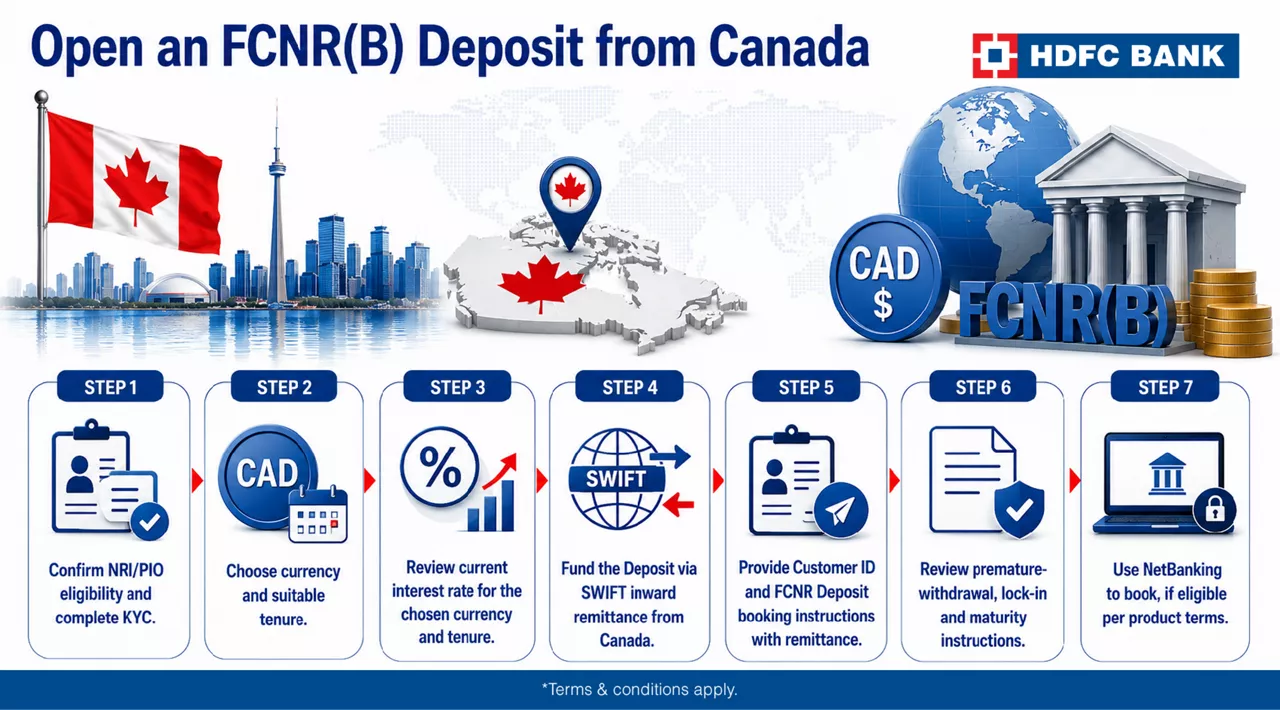
How to Open an FCNR(B) Deposit from Canada
Eligible NRIs and PIOs can consider the following process:
- Confirm your NRI or PIO eligibility and complete KYC requirements.
- Select the Deposit currency, such as CAD, and choose a suitable tenure.
- Check HDFC Bank’s latest FCNR Deposit interest rate for the selected currency and tenure.
- Fund the Deposit through a SWIFT inward remittance from Canada or another eligible funding route.
- Provide your Customer ID and FCNR Deposit booking instructions with the remittance, where applicable.
- Review the premature-withdrawal, lock-in and maturity instructions before booking.
Existing HDFC Bank customers may also be able to book an FCNR Deposit through NetBanking, subject to applicable product terms and access rights.
Things to Consider Before Booking an FCNR(B) Deposit
Before opening an FCNR(B) Deposit from Canada, review:
The currency in which you expect to need the funds at maturity
The current rate available for the selected currency and tenure
Whether the funds can remain invested for at least one year
SWIFT, intermediary-bank and currency-conversion charges
Tax reporting requirements in Canada
The total value of foreign assets for Form T1135 assessment
Premature-withdrawal rules and maturity instructions
At HDFC Bank, no interest is paid if an FCNR Deposit is withdrawn before completing one year. For premature withdrawals after one year, no premature-closure penalty is levied, but interest is recalculated based on the rate applicable on the booking date for the completed period of the Deposit.
Conclusion
For NRIs in Canada, an FCNR(B) Deposit can add a foreign-currency Fixed Deposit option to a savings toolkit that may already include Canadian bank accounts, GICs and TFSAs.
It may be relevant for funds that need to remain in CAD or another eligible foreign currency while being held with an Indian bank for a fixed tenure. Before booking, review the Deposit currency, tenure, liquidity needs, Canadian tax obligations, Form T1135 position and HDFC Bank’s latest FCNR Deposit terms and rate card.
Disclaimer: Terms and conditions apply. The information provided in this article is generic in nature and for informational purposes only. It is not a substitute for specific advice in your own circumstances. Rates and terms are subject to change. Please refer to HDFC Bank’s official FCNR(B) rate card for the most current information. Please consult a qualified Canadian tax professional and review HDFC Bank’s latest FCNR Deposit terms before booking.
For Canadian tax residents, foreign interest income is generally required to be reported in Canadian Dollars when filing a Canadian tax return. FCNR(B) interest may be exempt from Indian income tax, but the Canadian tax treatment depends on the depositor’s tax residency and circumstances.
A TFSA is a Canadian registered account with contribution-room rules and tax treatment under Canadian law. An FCNR(B) Deposit is a foreign-currency Fixed Deposit in India for eligible NRIs and PIOs. They serve different purposes and can be considered separately based on individual needs.
You may need to file Form T1135 if you are a Canadian tax resident and the total cost amount of all your specified foreign property exceeds CAD 100,000 at any time during the year. Funds held with an Indian bank may be relevant to this calculation. Consult a Canadian tax professional for guidance specific to your holdings.
Yes. HDFC Bank offers FCNR Deposits in Canadian Dollars, subject to eligibility and applicable terms. The minimum CAD Deposit amount is CAD 1,000.
An FCNR(B) Deposit can be booked through a SWIFT inward remittance from Canada or through another eligible funding route. Existing HDFC Bank customers may also be able to use an eligible NRE Account through NetBanking, subject to applicable terms.

Related Blogs


Make the most of your savings with our foreign
currency deposits