
Frequently Asked Questions
Digital Banking
What Is Phone Banking?
Understand what phone banking is, the services it offers, and how to bank securely over a call.
Synopsis
Phone Banking allows you to perform various banking activities using your mobile.
Phone Banking provides a range of services including balance inquiries, mini statements and chequebook requests.
The benefits of phone banking include the convenience of conducting transactions from anywhere, 24/7 access to services and significant time savings.
Overview
Phone banking allows you to perform a range of banking activities through your mobile or landline phones. As one of the many banking services introduced to enhance customer convenience, phone banking bridges the gap between branch-based banking and modern digital banking solutions. This service is particularly significant in a country like India, where the geographical spread and the digital divide make it imperative to have multiple channels for banking services. Read on learn what is tele banking.
What Is Phone Banking And How Does It Work?
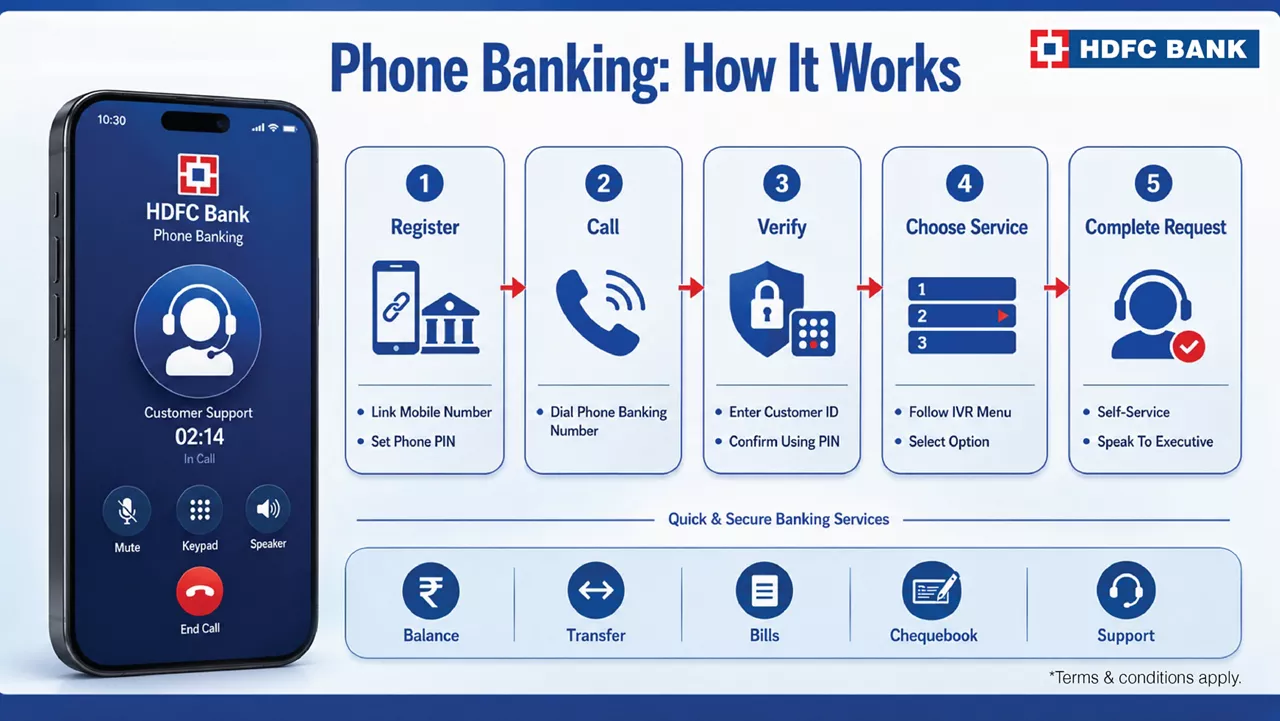
Here is a step-by-step overview of how it works:
You need to register for Phone Banking services. This usually involves linking your phone number with your bank account and setting up a Personal Identification Number (PIN) for secure access.
Once registered, you can access phone banking by calling a dedicated Phone Banking number provided by your bank.
To ensure security, you must verify your identity. This often involves entering your account number or customer ID and your phone banking PIN.
After verification, you are presented with a menu of options via an IVR system. These options typically include balance inquiries, fund transfers, bill payments, chequebook requests and more.
You can navigate through the menu using your phone’s keypad to select the desired service. For complex queries, you may be directed to a customer service representative.
Services Offered Through Phone Banking
Here are some of the key services offered by phone banking:
Balance Inquiry: You can check your account balance instantly.
Mini Statements: You can obtain a summary of recent transactions.
Chequebook Request: You can request a new chequebook.
Stop Payment Requests: Place a stop payment on checks.
Loan Information: Get details about existing loans, EMIs due, etc.
Card Services: Report lost or stolen cards, request new cards and get information about card transactions.
Account Information: Get information about account status, interest rates and other services.
Security Measures in Phone Banking
Banks employ several measures to protect customer information and transactions:
PINs and Passwords: You must use a phone banking PIN or password to access services.
Two-Factor Authentication: Some banks may use additional verification methods, such as OTPs (One-Time Passwords) sent to the customer’s registered mobile number.
Secure Lines: Calls to phone banking services are typically conducted over secure lines to prevent eavesdropping.
Benefits of Phone Banking
Phone banking offers several benefits as follows:
You can perform banking transactions from the comfort of your home or office, without the need to visit a branch.
Phone Banking is accessible from anywhere, making it ideal for those in remote areas or those who travel frequently.
Many Phone Banking services are available 24/7, providing round-the-clock access to banking services.
By eliminating the need to visit a branch, Phone Banking saves you valuable time.
Use Phone Banking For A Smooth Banking Experience
Phone Banking has evolved significantly, offering a convenient, accessible and secure way for you to manage your finances. HDFC Bank’s phone banking allows you to check balances, transfer funds, pay bills and more by calling their dedicated number and following the IVR prompts. Technological innovations ensure phone banking remains vital, providing greater convenience and efficiency for you.
*Disclaimer: Terms and conditions apply. The information provided in this article is generic in nature and for informational purposes only. It is not a substitute for specific advice in your own circumstances.
Help us know you better
Which types of content do you find most valuable on our credit card blog? (Select all that apply)
Which types of content do you find most valuable on our credit card blog? (Select all that apply)
No. Phone Banking works over a mobile or landline call, so an internet connection is generally not required.
Many banks offer Phone Banking services round the clock, though certain services may have specific timings.
You typically need your registered phone number, Customer ID or account details, and a Phone Banking PIN for verification.
Yes. Depending on your bank, you can request services such as cheque books, account information, card assistance, and other banking support over the phone.

Related Blogs


Go digital with a secure, paperless account.