Frequently Asked Questions
Tech Blog
How Enterprise Agentic Integration (EAI) Helps Banks Ride the GenAI Wave
AI agents can reason, plan, and strategise, which is why an agent gateway is necessary to ensure safety.
Synopsis:
- In this article, Amit Sehgal, Ankur Singh, Rajat Mishra, and Satendra Kumar explains how agentic integration can improve the business processes.
However, an ungoverned maze of AI systems talking to each other can lead to chaos and security violations.
For safe integration of AI agents, Agent Gateway that understands intent, state, and trust become necessary.
Overview
As banks adopt AI agents that can reason and take actions, integrating them into the existing system can lead to a series of challenges revolving around security, governance, scale challenges, and coupling issues. This article explains how an Agent Gateway can manage communications between the AI agents and enterprise applications safely.
The Evolution of Enterprise Integration
Whenever there is a new tech, there is drama. Everyone tries to integrate it into everything, which leads to chaos until a getaway is built to save us. This is exactly what happens to Agents, MCP, and protocols that understand what you are asking for.
There was a time when everything lived in a single giant codebase. But then came microservices after which business logic got chopped into bite-sized services and everything exposed REST APIs. And when these were integrated without rules, companies ended up with spaghetti connections and security nightmares.
This is where API Gateways swooped in to act as a cop that manages traffic, authentications, speed limits, and acts as a universal translator and the all-seeing eye.
Enter the Era of AI Agents
AI agents now communicate differently from the traditional applications.
• REST calls become A2A (Agent-to-Agent) or ACP (Agents Communication Protocol).
• Agents don’t just carry JSON, but also carry the intent, context, and memory.
• Conversations become semantic like talking to a smart colleague vs. Filling out forms.
| Old School (API World) | New Hotness (Agentic World) |
|---|---|
| REST API | A2A / ACP Protocol |
| Function | MCP |
| Microservice | Agent |
| API Gateway | Agent Gateway |
MCPs act as the atomic reasoning units and define how agents interact with tools, data, and APIs. They bring order to the chaos by being the function signature for the AI era.
The Role of AI Agents
Agents are fundamentally different from microservices. They are stateful and have memory. They can also reason, plan, and strategize. They team up dynamically, which can be helpful but also terrifying without guardrails.
Just like Enterprise Application Integration (EAI) patterns saved microservices architecture, they’re making a comeback for agents. Some emerging agentic patterns are:
Supervisor Agent Pattern: One boss agent coordinates the chaos
Agent Saga Pattern: Long-running workflows that don’t fall apart
Policy Enforcement Agent: The rule keeper that nobody likes but everyone needs
Memory Isolation Pattern: Keep secrets actually secret
Planner–Executor Pattern: Think first, act later
From Experimentation to Production
Data science has mostly lived in Jupyter notebook land. But GenAI changed everything:
Suddenly DS models need to scale
They need APIs (or agents now)
They need monitoring, versioning, CI/CD
They need all the engineering discipline that backend devs take for granted
For engineers building customer-facing apps, load balancing, rolling deployments, circuit breakers, and A/B testing infrastructure are basics. However, for data scientists coming from notebooks, these may be unfamiliar.
GenAI is pushing data science to grow up fast. Engineering marvels like model serving platforms, feature stores, ML observability, and automated retraining pipelines are now being applied to GenAI systems to build enterprise-grade customer apps.
Why an Agent Gateway is Necessary
Without a gateway, agents ping each other directly, context bleeds everywhere, and memory gets shared. There won’t be consistent policies and visibility. This leads to an ungoverned maze of AI systems talking to each other. It’s the API spaghetti problem, but way worse because these things can reason.
An agent gateway does the following:
Enforce RBAC and policies, which determines who can talk to whom.
Rate limitings and quotas to stop runaway agents
Memory management to control what gets shared
Agent discovery to find the right agent for a job
Audit trails which will make the compliance folks love you
Protocol translation where A2A/ACP magic happens
Core banking APIs like payments, ledgers, credit systems, and account management are not going anywhere. Instead, they get wrapped in MCP, are called by agents, and routed through agent gateway.
A Practical Example of a DIY Wealth App
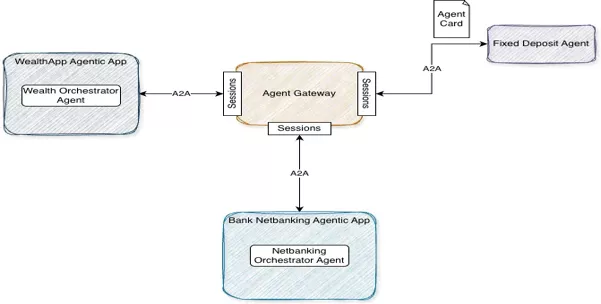
A bank launches a DIY Wealth App that needs Fixed Deposit recommendations, loan eligibility checks, and smart cross-sell suggestions. In the traditional approach, the app directly integrates with separate APIs for FD service, loan service, and product catalogue. This leads to tight coupling, version dependency, and logic duplicated across teams.
However, in the Agent way, FD team builds FD Agent. loan team builds loan Agent, and App talks to Wealth Orchestrator Agent.
When a customer checks surplus cash, the Wealth Agents look at how this person’s money can be optimised. The agent gateway steps in to discover FD Agent and Loan Agent, checks permissions, enforces policies, and manages context boundaries.
The FD Agent analyses ideal deposit options, and the Loan Agent evaluates prepayment vs. leverage opportunities. The gateway orchestrates and the app receives a personalised recommendation.
What the Future May Look Like
REST becomes plumbing (still there, just hidden)
A2A/ACP becomes the integration language
Agents become your deployment units
Gateways govern intelligence flows, not just endpoints
Closing Thought
Banks can now run agents like microservices. Different agent like the Loans Agent, Credit Card Agent, and Wealth Agent will be deployed and owned by different teams. The Agent Gateway becomes the lobby where the different agents interact securely.
Despite challenges, the banks that win will apply microservices discipline, reuse EAI patterns, treat agents as first-class citizens and apply engineering rigor to AI systems. An Agent Gateway is not a choice but rather, it becomes the foundation for everything you build.
No. REST APIs will continue to support core banking functions; however, agents may interact with these APIs through MCP and Agent Gateways.
RBAC and policy enforcement can restrict what an agent is allowed to access or share. An Agent Gateway ensures audit trails which records activity.
AI Agents are capable of reason, can use tools, access information, and act independently. Governance is necessary to ensure that controls are in place to make AI agents do their job safely.
