Taxes
What is Professional Tax?
Learn what professional tax is, who pays it, its slabs across states, and how it is deducted.
Synopsis:
Eligible individuals are required to pay professional tax to the state.
Not all states in India levy professional tax.
Employers deduct professional tax from employee salaries and pay it to the government.
Overview
As a salaried individual, you may have noticed the term ‘professional tax’ in your salary slip. Professional tax is deducted from your total pay. This tax is levied by the state on various professions. This means that professional tax is not limited to only salaried individuals. In this article, you can get more information on what professional tax in salary slip is.
What is Professional Tax?
Professional tax (PT) is a levy imposed by state governments on individuals earning an income through any means. Despite its name, it applies to all individuals across various professions, occupations, callings, employment and trades.
Under Section 16(iii) of the Income Tax Act of 1961, deductions can be made on account of tax per clause (2) of article 276 of the constitution. Per this clause, the total amount you pay to the state or municipality, district board, local board or other local authority in the state by way of taxes on professions, trades, callings and employments shall not exceed ₹2,500 in a year.
Who Collects Professional Tax?
Professional tax is collected by the state. However, not all states collect professional tax. According to Article 246 of the Indian Constitution, only Parliament has the authority to enact legislation concerning income tax. However, state governments can pass laws regarding certain taxes, including professional tax, under Article 276 of the Indian Constitution. This allows states to legislate and collect professional tax independently. Professional tax is collected by the respective state’s Commercial Tax department.
Some states that collect professional tax include Maharashtra, Gujarat, Tamil Nadu, Karnataka, Telangana, Kerala, Madhya Pradesh and Odisha among others. States and union territories that do not levy professional tax include Jammu and Kashmir, Haryana, Uttarakhand, Delhi, Uttar Pradesh, Daman and Diu and Dadra and Nagar Haveli, among others.
Who is Liable to Pay Professional Tax?
Any entity engaged in any profession, trade, calling or employment within a state is liable to pay professional tax. This includes Hindu undivided families, firms, companies, corporations or other corporate bodies, societies, clubs or associations.
For employees, the employer is responsible for deducting and paying professional tax to the state government. Employers, including corporations, partnership firms and sole proprietorships, must also pay professional tax on their trade or profession.
Other individuals have to directly pay professional tax to the Government or through their respective local bodies. They can do so online on the respective state’s tax payment website or visit an authorised body to pay the tax offline.
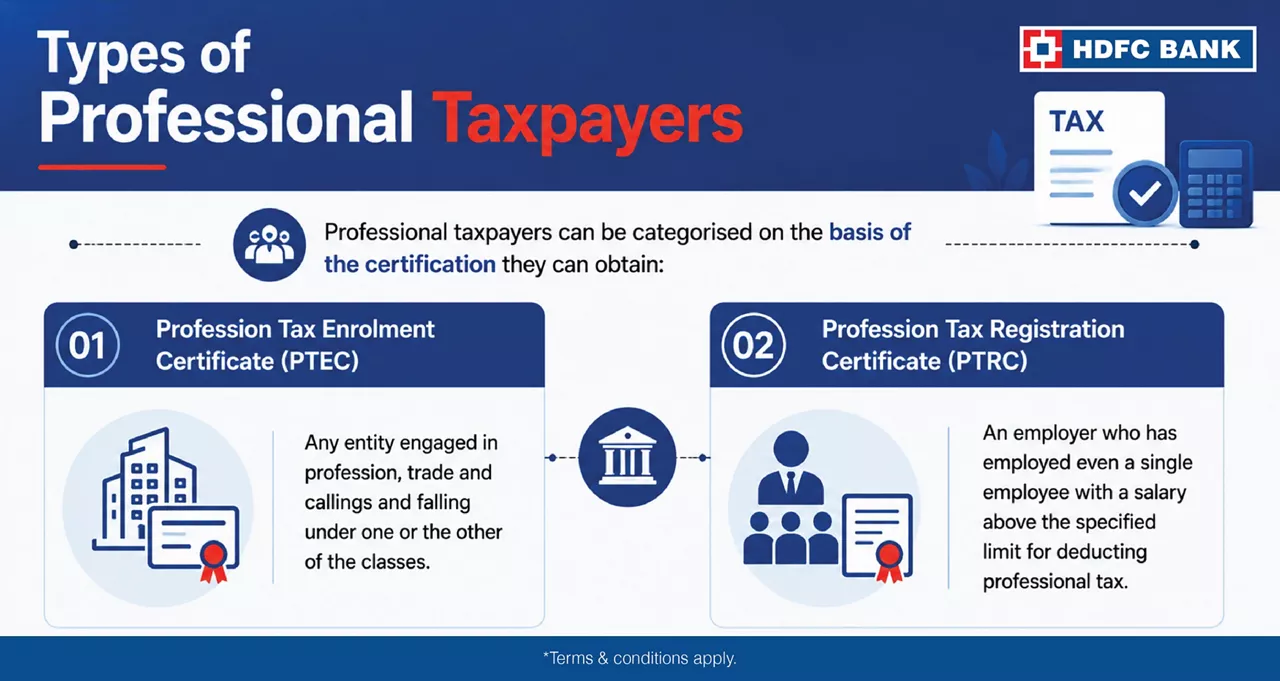
Types of Professional Taxpayers
Professional taxpayers can be categorised on the basis of the certification they can obtain:
Profession Tax Enrollment Certificate (PTEC): Any entity engaged in profession, trade and callings and falling under one or the other of the classes.
Profession Tax Registration Certificate (PTRC): An employer who has employed even a single employee with a salary above the specified limit for deducting professional tax.
Employers need to register and obtain both PTRC and PTEC. Separate registrations may be required for each office, depending on the state.
What is the Professional Tax Slab Rate?
The tax rates for professional tax can vary across states. Below are a few state-wise tax rates for salaried individuals:
1. Professional Tax in Maharashtra
| Monthly Salary Range | Professional Tax |
|---|---|
| For men, if the monthly salary/wage is up to ₹7,500 | No PT |
| For women, if the monthly salary/wage is up to ₹10,000 | No PT |
| For men, if the monthly salary/wage exceeds ₹7,500 but does not exceed ₹10,000 | ₹175 PT per month |
If salary/wage exceeds ₹10,000
|
₹2,500 per annum to be paid in following manner (a) ₹250 per month except for the month of February (b) ₹300 for the month of February |
2. Professional Tax in West Bengal
| Monthly Salary Range | Professional Tax |
|---|---|
| Up to ₹7,000 | No PT |
| ₹7,001 to ₹8,000 | ₹50 |
| ₹8,001 to ₹9,000 | ₹90 |
| ₹9,001 to ₹15,000 | ₹110 |
| ₹15,001 to ₹25,000 | ₹130 |
| ₹25,001 to ₹40,000 | ₹150 |
| ₹40,001 and above | ₹200 |
3.Professional Tax in Tamil Nadu
| Six Month’s Income | New Tax |
|---|---|
| Up to ₹21,000 | No PT |
| ₹21,000 to ₹30,000 | ₹100 |
| ₹30,001 to ₹45,000 | ₹235 |
| ₹45,001 to ₹60,000 | ₹510 |
| ₹60,001 to ₹75,000 | ₹760 |
| ₹75,001 and above | ₹1,095 |
4.Professional Tax in Gujarat
| Monthly Salary Range | Professional Tax |
|---|---|
| Up to ₹2,999 | No PT |
| ₹3,000 to ₹5,999 | ₹20 |
| ₹6,000 to ₹8,999 | ₹80 |
| ₹9,000 to ₹11,999 | ₹150 |
| ₹12,000 and above | ₹200 |
5.Professional Tax in Sikkim
| Monthly Salary Range | Professional Tax |
|---|---|
| ₹20,000 or less | No PT |
| ₹20,001 to ₹30,000 | ₹125 |
| ₹30,001 to ₹40,000 | ₹50 |
| ₹40,001 and above | ₹200 |
Professional Tax Exemptions
Members of the Armed Forces of the Union, members of the Central Reserve Police Force (CRPF) and physically disabled individuals with total disability are exempted from professional tax payment.
Final Note
As a professional, you are required to pay a professional tax. This tax is paid to the state and associated terms and conditions can vary across states. If you’re employed with a company, the company will deduct the tax from your salary and pay it to the government. If you’re self-employed, you can pay the tax online or offline, depending on your state.
Are you eligible to pay professional tax online? Use your HDFC Bank Debit Card, Credit Card or NetBanking for seamless tax payment.
*Disclaimer: Terms and conditions apply. The information provided in this article is generic in nature and for informational purposes only. It is not a substitute for specific advice in your own circumstances. You are recommended to obtain specific professional advice from before you take any/refrain from any action. Tax benefits are subject to changes in tax laws. Please contact your tax consultant for an exact calculation of your tax liabilities.

