Frequently Asked Questions
Demat Accounts
What is Nifty IT Index: Meaning, Eligibility, Calculation & Benefits
Explore the Nifty IT Index, stock selection, calculation, benefits, and ways to invest confidently in technology.
Synopsis
- The Nifty IT Index represents India's leading IT companies and tracks sector performance.
- It is calculated based on market capitalisation, liquidity, and free-float methodology.
- Investors can invest via stocks, ETFs, mutual funds, or derivatives.
- The index offers diversification, growth potential, and reduced risk compared to individual stocks.
Overview
The Indian IT sector has been a powerhouse of growth, driving innovation and contributing significantly to the economy. Investors looking to capitalise on this sector often track performance through market indices. One such index is the NIFTY INDEX, which provides a benchmark for various industry segments, including IT.
Among them, the Nifty IT Index stands out as a critical measure of the IT sector’s market trends. This article explores its meaning, stock selection criteria, calculation methodology, and the benefits it offers to investors
What is Index Nifty?
An index is a collection of stocks chosen based on specific criteria, thus facilitating easier tracking of market trends by investors. INDEX NIFTY is one of India's leading stock indexes, operated by the National Stock Exchange (NSE). It contains 50 frequently traded shares from various sectors, providing a broad market representation.
Sectoral indices like the Nifty IT Index are part of this ecosystem. They focus on industry-specific stocks to give a clearer picture of sectoral performance. These indices help investors make informed decisions by providing them with information about particular segments of the market.
What is Nifty IT Index?
Nifty IT Index is a sector index on the NSE that reflects the top IT companies in India. It depicts the performance of the IT industry by including top actively traded technology companies.
This index is critical for tracking the financial health of the IT industry as well as market sentiment. It comprises industry leaders such as, Tata Consultancy Services (TCS), Infosys, Wipro, etc. The index is used extensively by analysts and investors to study sectoral performance, compare individual stocks, and gauge investment opportunities in India's IT industry.
How Is the Nifty IT Index Value Calculated?
The Nifty IT Index is calculated using the free-float market capitalisation method. This approach ensures that only publicly available shares contribute to the index value, making it a reliable reflection of market trends.
The formula used for calculation is:
Index Value = ∑(Free-Float Market Capitalisation of All Stocks)/ Base Market Capitalisation × Base Index Value
Here’s how it works:
Market Capitalisation Calculation – Multiply each company's stock price by the number of free-floating shares.
Base Market Capitalisation – The base value of the index is set at a specific time for consistency.
Index Adjustment – Adjustments are made for stock splits, bonus issues, and other corporate actions.
Since the IT sector is dynamic, the index undergoes periodic revisions to ensure that it accurately reflects industry performance.
How Are Stocks Selected in the Nifty IT?
Stocks included in the Nifty IT Index must meet certain eligibility criteria. The selection process is based on:
Listing on NSE – The stock must be traded on the National Stock Exchange.
Sector Classification – Only companies classified under the IT sector are considered.
Liquidity and Trading Volume – Stocks must have a high average daily turnover.
Market Capitalisation – The company should have a significant market value to impact the index meaningfully.
Free-Float Market Cap – Only stocks with a substantial percentage of publicly available shares are included.
The index is reviewed semi-annually, ensuring it remains relevant and accurately represents the sector.
Stock Nifty IT Index
The Nifty IT Index comprises India's leading IT companies. Below is a list of some of the prominent companies that are currently part of the index:
Infosys: Infosys is an international IT leader, with expertise in digital services and technology innovations. It demonstrates robust stock market performance, indicating stability and flexibility.
Tata Consultancy Services (TCS): TCS, the biggest IT company in India, dominates technology solutions across the world. Its relentless innovation solidifies its position as a leader in the IT sector.
Wipro: Wipro provides multifaceted IT and consultancy services, specializing in digital change and global outreach.
Info Edge (India): Info Edge excels in internet ventures and seed investment, establishing deeper roots in the digital segment.
HCL Technologies: HCL is expertise-based in software services of the future, spurring innovation industry-wise.
Tech Mahindra: Tech Mahindra shines at telecom and engineering services with robust digital dominance.
Larsen & Toubro Infotech: L&T Infotech offers innovative consulting solutions across industries.
Mphasis: Mphasis deals in cloud and financial services, maintaining global efficiency.
MindTree: MindTree specialises in e-commerce and cloud, keeping customers at the center.
Coforge: Coforge enhances digital capabilities in travel and insurance.
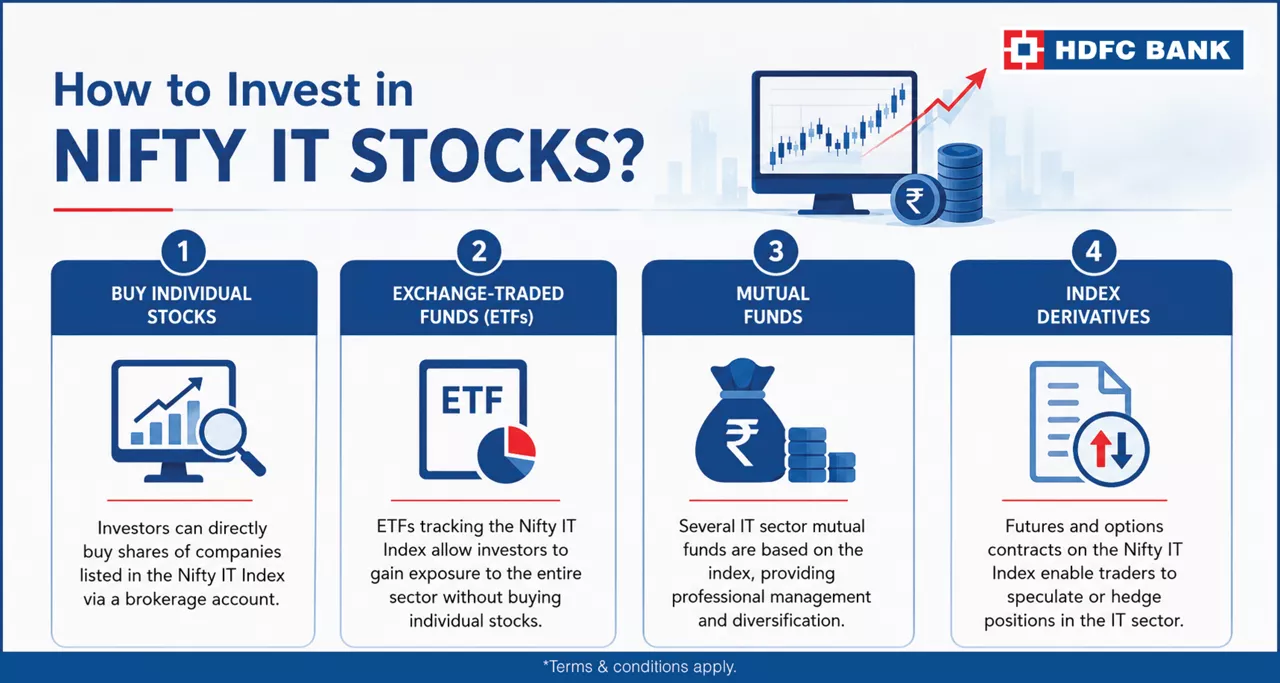
How to Invest in Nifty IT Stocks?
Investors can participate in the Nifty IT Index through multiple investment avenues. Here’s how:
Buying Individual Stocks – Investors can directly buy shares of companies listed in the Nifty IT Index via a brokerage account.
Exchange-Traded Funds (ETFs) – ETFs tracking the Nifty IT Index allow investors to gain exposure to the entire sector without buying individual stocks.
Mutual Funds – Several IT sector mutual funds are based on the index, providing professional management and diversification.
Index Derivatives – Futures and options contracts on the Nifty IT Index enable traders to speculate or hedge positions in the IT sector.
Investors should conduct thorough research, track sector performance, and consider market trends before investing in IT stocks.
What Are the Benefits of Investing in the Nifty IT?
Investing in the Nifty IT Index has several benefits:
- Sector Exposure
The index gives targeted exposure to India's thriving IT industry, enabling investors to take advantage of its steady growth. - Diversification
Investment in an index fund or ETF provides exposure to several companies at once, minimising risk relative to direct investment in individual stocks. - Performance Benchmark
The index is a benchmark for IT-oriented portfolios, enabling fund managers as well as retail investors to compare their investment performance. - Growth Potential
India's IT sector is a world leader, and by investing in the Nifty IT Index, the investor gets an opportunity to participate in this high-growth industry. - Lower Risk Compared to Individual Stocks
While individual stocks may face company-specific risks, an index-based approach spreads the risk across multiple firms. - Passive Investment Opportunity
Index funds and ETFs tracking the Nifty IT Index provide a passive investment route, requiring minimal management effort.
Conclusion
The Nifty IT Index offers investors a simple way to track the performance of India's leading technology companies. Whether you're looking for sector-specific exposure, portfolio diversification, or long-term growth opportunities, understanding how the index is constructed and the factors that influence it can help you make informed investment decisions. Investors can gain exposure through individual stocks, ETFs, index funds, or other investment avenues based on their financial goals and risk appetite.
*Disclaimer: Terms and conditions apply. The information provided in this article is generic in nature and for informational purposes only. It is not an investment recommendation. Investments are subject to market risks and other risks.
The index is reviewed every six months to ensure it reflects the performance of the IT sector accurately.
Foreign investors can invest either through Foreign Portfolio Investment channels or by purchasing index-tracker mutual funds.
No, it has technology consulting firms, software companies, and IT service providers.
Yes, looking at the consistent growth of India's IT sector, long-term investors can look at it as a good investment option.
Investors can track its performance on the NSE website itself, stock market apps, or financial websites.
Infosys, TCS, Tech Mahindra, Wipro, Info Edge (India), HCL Technologies, Larsen & Toubro Infotech, Mphasis, MindTree and Coforge are currently part of Nifty IT index.

Related Blogs


Secure future begins with smart investing