Frequently Asked Questions
Investment
What is BSE (Bombay Stock Exchange): Overview, Functions, and Key Indices
Discover how BSE supports investing through transparent trading, key indices, and efficient market infrastructure in India.
Synopsis:
- BSE (Bombay Stock Exchange) is India’s oldest stock exchange, established in 1875.
- Located on Dalal Street, Mumbai, it provides a regulated marketplace for trading equities, derivatives, bonds, and mutual funds.
- BSE ensures transparent, efficient transactions through its electronic trading system, BOLT.
Overview
The stock market plays an essential role in a nation's financial system, helping companies in raising funds and enabling investors to grow their wealth. The Bombay Stock Exchange, referred to as BSE, established in 1875 and it is one of the Asia’s oldest stock exchanges and serves an essential function in India's economic growth.
It is located at Dalal Street, Mumbai, and offers a platform to deal in equities, debt instruments, mutual funds, derivatives, and many more. It has more than 6,000 listed companies.
BSE facilitates capital formation by allowing businesses to raise funds through the issuance of shares and bonds. It also serves as a regulated marketplace for investors to buy and sell securities efficiently and transparently.
How Does BSE Work?
BSE operates through a fully electronic trading system known as BOLT (Bombay Online Trading). This platform ensures seamless transactions, allowing buyers and sellers to trade without the need for physical presence. Key aspects of BSE's operations include:
Trading Electronically: Investors submit buy/sell orders via brokers or online trading platforms.
T+2 Settlement Cycle: Transactions are finalised within two business days following execution.
Direct Market Access (DMA): Institutional investors can trade directly without using intermediaries.
Governing Body: The Securities and Exchange Board of India (SEBI) guarantees equitable and clear trading practices.
Listing and Trading on BSE
Companies looking to raise capital through BSE India must complete a listing process. The three primary methods for listing shares on the exchange are:
Initial Public Offering (IPO): A company offers its shares to the public for the first time, allowing investors to purchase equity. This helps the company raise funds for expansion, debt repayment, or new projects.
Follow-on Public Offering (FPO): A company that is already listed on BSE issues more shares to generate additional capital. This approach is commonly utilized to fund business expansion, acquisitions, or reorganisation.
Direct Listing: Companies listed on other stock exchanges can directly list on BSE without issuing new shares. This provides greater market access, enhances liquidity, and allows existing shareholders to trade on BSE.
Once listed, a company’s shares become open for public trading. Investors can purchase or sell shares depending on market demand, and prices vary based on supply and investor sentiment. BSE guarantees a clear and effective trading environment via its electronic trading system. Companies that are listed are required to adhere to the regulatory standards established by the Securities and Exchange Board of India (SEBI) to keep their listing active and to protect investors. Trading on the BSE grants companies access to public capital while presenting investment opportunities to market participants.
List of BSE Indices
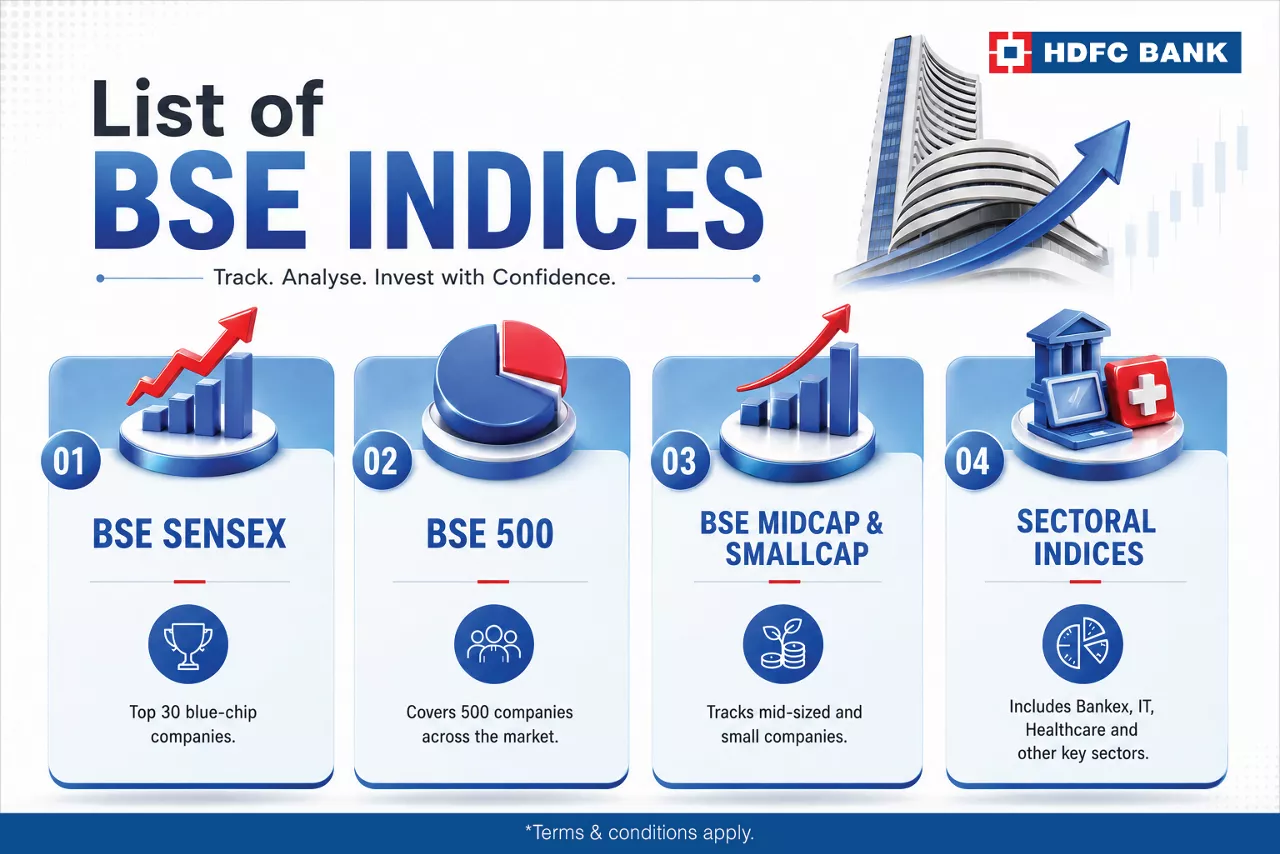
BSE has several indices that track different segments of the stock market. The most prominent ones include:
1. BSE SENSEX
The benchmark index, comprising the top 30 blue-chip companies from various sectors.
2. BSE 500
A broader index covering 500 companies, providing a comprehensive view of the market.
3. BSE Midcap & Smallcap
Tracks the performance of mid-sized and small companies, offering insights into emerging businesses.
4. Sectoral Indices
Includes BSE Bankex (Banking Sector), BSE IT (Technology Sector), and BSE Healthcare, among others.
Role of BSE in the Indian Economy
The Bombay Stock Exchange (BSE) plays a vital role in shaping India’s financial landscape by facilitating investments, ensuring market stability, and driving economic growth.
1. Encouraging Investments
BSE provides a reliable platform for both domestic and foreign investors to trade securities. By offering diverse investment opportunities, it attracts capital inflows, strengthens the financial market, and promotes long-term wealth creation.
2. Capital Formation
Businesses raise funds through Initial Public Offerings (IPOs), Follow-on Public Offerings (FPOs), and debt instruments on BSE. This capital is essential for business expansion, infrastructure development, and technological advancements, fostering industrial growth.
3. Market Regulation
BSE operates under the Securities and Exchange Board of India (SEBI), ensuring compliance with stringent regulations. By enforcing fair trading practices and transparency, it safeguards investor interests and maintains market integrity.
4. Economic Indicator
The SENSEX, which is the benchmark index of BSE, represents the overall economic condition of the nation. Market trends indicate investor sentiment, economic stability, and company performance, acting as a crucial gauge for policymakers and analysts.
5. Job Creation
BSE indirectly supports employment across multiple sectors, including finance, IT, manufacturing, and startups. By providing capital to businesses, it enables job creation, contributing to economic growth and stability.
Conclusion
The Bombay Stock Exchange (BSE) is a cornerstone of India's financial system, providing businesses with capital access and investors with wealth-building opportunities. With a rich history, technological advancements, and strong regulatory framework, BSE continues to drive the growth of the Indian economy. Whether you are a seasoned investor or a beginner, understanding BSE India can help you make informed financial decisions.
Start your investment journey with HDFC Sky! Trade stocks, ETFs, and derivatives seamlessly on a secure platform. Open a free Demat account today and access expert research, real-time insights, and transparent pricing. Download the HDFC Sky App now and invest smarter!
*Disclaimer: Terms and conditions apply. This is an information communication from HDFC Bank and should not be considered as a suggestion for investment. Investments in securities market are subject to market risks, read all the related documents carefully before investing.
BSE stands for Bombay Stock Exchange.
BSE is the oldest stock exchange in India, while NSE (National Stock Exchange) is the largest in terms of trading volume.
SENSEX is BSE’s benchmark index, tracking the top 30 companies from various sectors.
No, individuals must trade through registered brokers or online trading platforms.
BSE operates from 9:15 AM to 3:30 PM (Monday to Friday).
Companies can get listed through an IPO, FPO, or direct listing, meeting BSE and SEBI requirements.
Yes, BSE is regulated by SEBI, ensuring transparency and investor protection.
Trading involves brokerage fees, transaction charges, and regulatory levies.

Related Blogs


Secure future begins with smart investing