Frequently Asked Questions
Account
Nifty Smallcap 100: Opportunities in Emerging
It offers diversified exposure to emerging small‑cap companies, delivering strong long‑term growth potential despite higher volatility, making it suitable for patient, long‑horizon investors.
Synopsis
- Nifty Smallcap 100 offers diversified exposure to high-growth emerging companies in India.
- Despite short-term market volatility, long-term returns outperform major indices.
- Broad sector representation reduces risk while capturing multiple economic growth drivers.
- Regular rebalancing also allows for inclusion of liquid and financially stable small-cap leaders.
Overview
The Indian stock market offers a variety of investment avenues, catering to͏ different risk appetites and growth objectives. Among them, small-caps often attract investors seeking higher growth potential than large caps, but without venturing into the highly risky micro-caps. The Nifty Smallcap 100 index as a key͏ benchmark in this segment, tracking 100 of India’s top small-cap companies in India.
By providing a snapshot o͏f th͏ese ͏emerging fi͏rms, ͏the index all͏ows investors to͏ unde͏rstan͏d market trends, ͏identify promising opportuni͏ties, an͏d͏ divers͏ify their portf͏olios eff͏ecti͏vel͏y w͏hile͏ gaining exposur͏e to s͏ome of the fastest-growing e͏nterprises͏ in the country.͏
What ͏is͏ the Nifty Smallcap 100 Index?
The Nifty Smallcap 100 is͏ a stock market index on th͏e National Stock Exchange (NSE) that tracks the perfo͏rmance of͏ 100 small-cap companies. Th͏ese firms g͏eneral͏ly rank fro͏m the 251s͏t to the 350th positi͏on in ͏terms o͏f free-float mar͏ket capitalisation. Small-cap compani͏es occupy a middle ground in the market—they͏ ar͏e mor͏e esta͏blishe͏d than micro-cap͏ firms but͏ still possess con͏siderable gro͏wth potential compared to larger, more mature ͏co͏mpanies.
The Nifty ͏Smallcap 100 is a subset of ͏the broa͏der Nifty ͏Smallcap 250 index and is widely͏ used as a benchmark for small-c͏ap mutual funds and ETFs. It p͏ro͏vides investors with a structured wa͏y to͏ ͏assess͏ emerging co͏mp͏an͏ies’ p͏erforman͏ce while maintaini͏ng ͏diversi͏fied e͏xpo͏sure across vari͏o͏us sectors. The͏ index help͏s investors gauge trends, identify growth prospects, and unders͏tan͏d the mid-ti͏er s͏egm͏ent͏ of India’s͏ ͏equity mark͏e͏t.
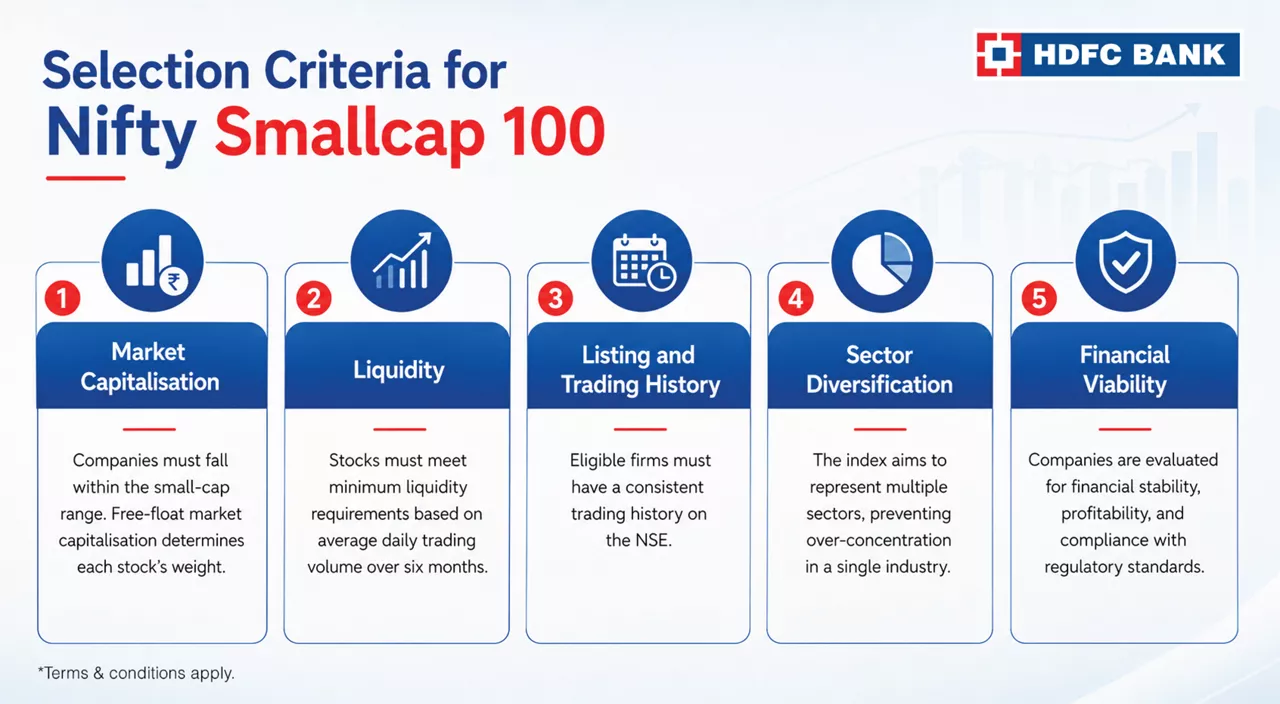
Selection Criteria for Nifty Smallcap 100
The Nifty Smallcap 100 follows a rigorous methodology to ensure it accurately reflects the performance of emerging small-cap firms:
- Market Capitalisation: Companies included in the index must fall within the small-cap range. Free-float market capitalisation determines each stock’s weight in the index, ensuring shares that are actively tradable have a greater impact.
- Liquidity: Stocks must meet minimum liquidity requirements, assessed by average daily trading volume over six months. This ensures investors can buy or sell shares efficiently without significant price disruption.
- Listing and Trading History: Eligible firms must have a consistent trading history on the NSE. This confirms the company has established operations and market presence.
- Sector Diversification: The index aims to represent multiple sectors, preventing over-concentration in a single industry and helping investors achieve balanced exposure.
- Financial Viability: Companies are evaluated for financial stability, profitability, and compliance with regulatory standards to ensure long-term sustainability.
The index undergoes semi-annual rebalancing, typically on January 31 and July 31. This process uses six months of average data to review stock performance, allowing companies that no longer meet the criteria to be replaced with more eligible small-cap firms. This ensures the Nifty Smallcap 100 stays aligned with market realities and reflects the most relevant emerging companies.
What Are the Constituent Companies of the Nifty Smallcap 100 Index?
The Nifty Smallcap 100 consists of 100 companies, each weighted according to its free-float market capitalisation. No single stock dominates the index, helping reduce concentration risk for investors in funds tracking the index.
Top Constituents of the Nifty Smallcap 100 Index (as of 30 January 2026)
- Multi Commodity Exchange of India Ltd. (MCX) – 6.12%
- Laurus Labs Ltd. – 3.56%
- Karur Vysya Bank Ltd. – 2.70%
- Central Depository Services (India) Ltd. (CDSL) – 2.23%
- Delhivery Ltd. – 2.19%
- Hindustan Copper Ltd. – 2.14%
- Navin Fluorine International Ltd. – 2.13%
- Radico Khaitan Ltd. – 2.10%
- Computer Age Management Services Ltd. (CAMS) – 1.58%
- Cholamandalam Financial Holdings Ltd. – 1.56%
The Nifty Smallcap 100 represents a wide range of sectors, reflecting the diversity of India’s small-cap market. Key sectors included in the index are (as of 30 January 2026):
- Financial Services – 32.35%
- Healthcare – 13.58%
- Capital Goods – 9.13%
- Chemicals – 8.24%
- Construction – 4.57%
- Consumer Durables – 4.54%
- Information Technology – 4.35%
- Oil, Gas & Consumable Fuels – 2.89%
- Fast Moving Consumer Goods (FMCG) – 2.78%
- Realty – 2.06%
- Metals & Mining – 2.14%
- Automobile and Auto Components – 1.73%
- Power – 1.67%
- Consumer Services – 1.32%
- Services – 6.11%
- Construction Materials – 1.34%
- Forest Materials – 0.63%
- Textiles – 0.31%
- Media, Entertainment & Publication – 1.20%
This sectoral diversity allows investors to tap into multiple growth engines within the economy, reducing dependency on a single sector and offering a well-balanced approach to small-cap investing.
What Are the Historical Returns of the Nifty Smallcap 100 Index?
Performance of NIFTY Smallcap 100 Index and Other Indices
Over the long term, the Nifty Smallcap 100 Index has consistently outperformed several major Nifty indices across 3-year, 5-year, and 10-year periods. With a 3-year return of 32.1%, it has remained ahead of both the Nifty Midcap 150 and the broader Nifty Smallcap 250.
Over five years, the index delivered around 22.6% returns, significantly higher than the 13.1% recorded by the Nifty 50. The long-term trend continues over ten years, where the Smallcap 100 posted a strong 18.8% CAGR, again outperforming large-cap benchmarks and reflecting the higher growth potential of small-cap companies.
Recent and Standalone Returns of the Nifty Smallcap 100 Index
As of January 30, 2026, the index shows short-term market fluctuations alongside solid long-term performance. The Quarter-to-Date (QTD) and Year-to-Date (YTD) returns stood at -4.68%, indicating recent corrections, while the 1-year return was 0.46%, showing relatively flat movement over the past year. However, the long-term picture remains strong, with a 5-year CAGR of 19.62% and a since inception CAGR of 14.97%, highlighting the index’s ability to generate wealth over extended periods despite periodic volatility.
Overall, the historical returns of the Nifty Smallcap 100 Index underline its high growth potential, balanced by higher risk, making a long-term investment horizon essential for investors seeking to benefit from the small-cap segment.
Conclusion
The Nifty Smallcap 100 provides investors with exposure to India’s dynamic small-cap segment, offering both growth potential and diversification. By tracking the top 100 emerging companies, it balances opportunity with risk, making it a valuable tool for building a resilient investment portfolio. While volatility is higher than large-cap indices, disciplined investing and long-term commitment can help investors capture the growth of India’s promising small enterprises.
*Disclaimer: Terms and conditions apply. The information provided in this article is generic in nature and for informational purposes only. It is not an investment recommendation. Investments are subject to market risks and other risks.
Yes. Beginners can gain exposure via index funds or ETFs tracking the Nifty Smallcap 100, avoiding complex stock selection.
The index is reviewed semi-annually, in January and July, to reflect changes in market capitalisation and liquidity.
No. It focuses on the 100 leading small-cap companies based on free-float market capitalisation and trading activity.
Investments carry higher risk due to volatility but also offer strong long-term growth potential for patient investors.
Investments carry higher risk due to volatility but also offer strong long-term growth potential for patient investors.