Frequently Asked Questions
Investment
What is Nifty Option Chain - Definition, Types and Strategies
Explore Nifty Option Chain, strike prices, open interest, and trading strategies for informed market decisions today.
Synopsis:
- The NIFTY option chain helps traders analyse market trends by displaying options contracts, strike prices, and open interest.
Key components like call & put options, bid-ask price, and ITM/OTM options determine trading decisions.
Traders use option chain data to predict price movements and assess liquidity.
Effective use of the NIFTY option chain enables better risk management and strategic trading.
Overview
Making the right trading decisions in the stock market isn’t just about luck—it’s about having the right tools. The NIFTY option chain helps traders decode market trends by providing a detailed view of available options contracts, strike prices, and open interest. But how do you read this data, and more importantly, how can you use it to your advantage?
This guide will walk you through everything you need to know, from understanding its components to trading strategies that can sharpen your market moves.
What is the Nifty Option Chain?
The NIFTY option chain is a structured listing of all available options contracts for the Nifty 50 index. It presents vital information such as open interest, volume, price movement, and strike prices for both call and put options. By displaying these data points in an organised manner, the NIFTY option chain helps traders analyse market trends and make informed decisions regarding their investments.
How to Read NSE Nifty Option Chain Data?
Interpreting the NIFTY option chain requires an understanding of its key metrics:
- Strike Price: This is the predetermined price at which an option can be exercised. For example, if a trader buys a call option with a strike price of ₹18,000 while NIFTY 50 is trading at ₹18,200, the option is already profitable (in-the-money).
- Call & Put Options: A call option allows traders to buy an asset at a set price, while a put option allows selling. Suppose a trader buys a call option for NIFTY 50 at ₹18,500, expecting prices to rise. If NIFTY 50 moves to ₹18,700, they can exercise the option and profit.
- Open Interest: This represents the total number of outstanding option contracts. A higher open interest at a strike price of ₹18,300 suggests strong market interest and liquidity.
- Bid & Ask Price: The bid price is the highest offer a buyer makes, while the ask price is the lowest a seller is willing to accept. For instance, if a call option has a bid price of ₹120 and an ask price of ₹125, traders need to decide the best entry point.
- Volume: This indicates the number of contracts traded in a session. If a put option at ₹18,200 has a high volume, it signals increased trading activity.
By analysing these elements, traders can gauge market sentiment and potential price movements.
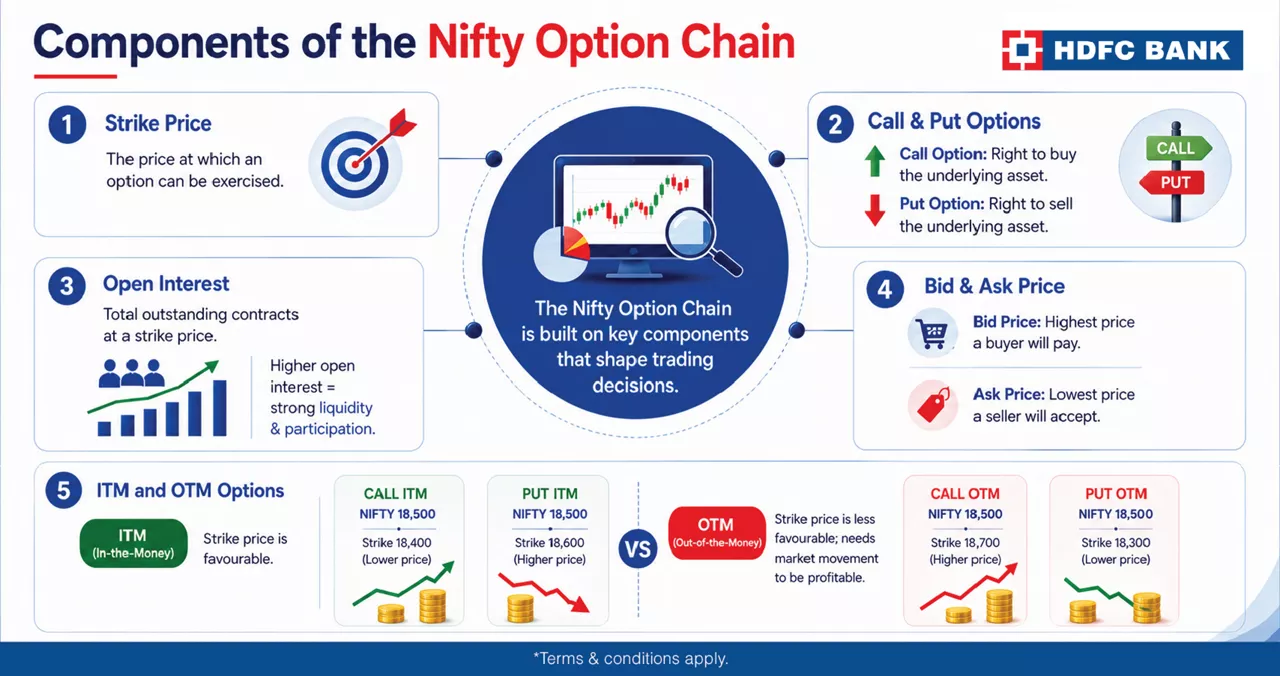
Components of the Nifty Option Chain
Several critical elements form the NIFTY option chain, each influencing trading strategies.
1. Strike Price
The strike price is the predetermined price at which an option can be exercised. It plays a crucial role in deciding the profitability of a trade.
2. Call & Put Options
Call Options: Provide the right, but not the obligation, to buy the underlying asset at a specific price before expiration.
Put Options: Grant the right to sell the underlying asset at a predetermined price before expiry.
3. Open Interest
Open interest reflects the total number of outstanding options contracts at a particular strike price. A higher open interest indicates strong market participation and liquidity.
4. Bid & Ask Price
Bid Price: The highest price a buyer is willing to pay.
Ask Price: The lowest price at which a seller is willing to sell.
5. ITM and OTM Options
In-the-Money (ITM) Options: These options have strike prices that are favourable compared to the current market price. For example, if NIFTY 50 is trading at ₹18,500, a call option with a strike price of ₹18,400 is in-the-money since the trader can buy at a lower price. Similarly, a put option with a strike price of ₹18,600 is ITM, as it allows selling at a higher price than the market value.
Out-of-the-Money (OTM) Options: These options have strike prices that make them less likely to be profitable unless the market moves in the desired direction. For instance, if NIFTY 50 is at ₹18,500, a call option with a strike price of ₹18,700 is OTM since the market price is still below the strike price. A put option with a strike price of ₹18,300 is also OTM, as selling at a lower price than the market would result in a loss.
Trading with Nifty Option Chain
Using the NIFTY option chain effectively requires a strategic approach:
- Identify Market Trends: By evaluating open interest and volume data, traders can predict price movements.
- Assess Liquidity: High open interest suggests better liquidity, making it easier to enter or exit positions.
- Analyse Premiums: The price of an options contract (premium) helps determine the potential risk and reward.
- Monitor Support & Resistance Levels: Strike prices with significant open interest can indicate key support and resistance levels.
- Use Hedging Strategies: Options can be used to hedge existing stock positions against market volatility.
Example
Suppose a trader expects stock X to rise from its current price of ₹100. They purchase a call option with a strike price of ₹110 and a premium of ₹5. If the stock price rises to ₹115, the trader can exercise the option and make a profit of ₹5 per share. However, if the price falls below ₹100, the trader only loses the premium paid.
The NIFTY option chain serves as a valuable tool for traders looking to make informed market decisions. By understanding its components and applying strategic trading methods, investors can effectively manage risks and enhance their chances of profitability.
Conclusion
The Nifty Option Chain is an essential tool for understanding market sentiment, identifying trading opportunities, and managing risk. By analysing key metrics such as strike prices, open interest, and option premiums, traders can make more informed decisions and develop effective trading strategies. Whether you're a beginner or an experienced trader, learning to interpret option chain data can strengthen your overall trading approach.
*Disclaimer: Terms and conditions apply. The information provided in this article is generic in nature and for informational purposes only. It is not an investment recommendation. Investments are subject to market risks and other risks.
Open interest helps traders assess the liquidity and strength of a trend at a specific strike price.
Call options give traders the right to buy an asset, while put options allow them to sell it at a predetermined strike price.
By analysing strike prices, premiums, and open interest, traders can hedge positions and limit potential losses.
A smaller bid-ask spread indicates higher liquidity, ensuring traders can execute trades at favourable prices.
ITM options have intrinsic value, making them more expensive, while OTM options are cheaper but riskier, requiring a significant price move to become profitable.

Related Blogs


Secure future begins with smart investing